Wednesday, November 12, 2014

November 12th, 2014: Some more news on Everest permits

Alan Arnette posted a quick update on the Everest permit situation for 2015 for those of us who were barred from climbing in 2014.  The update came from the online paper "The Himalayan Times" and painted a grim picture of what is in store for us.  Click on the link in the previous sentence to read the full article.  The headline reads "Govt extends group permits by five years:  If any member of an expedition scales Mt Everest‚ permits of others automatically become invalid."  Ouch!  It seems as if the Nepal government is doing everything in their power to rescind those 2014 permits and force climbers to pay more for less service.  I don't know the real situation but I commented on Alan's blog saying...
Alan,
Thanks for posting this article. The way I read it is first-come, first-served. Those who delay in their return (with the same expedition) forfeit their permit fees. I see this is a ploy for them to cash in again on the climbers – nothing new for a corrupt government. Climbers who cannot or do not put Everest as their number one priority pay a steep fee. ‘Tis a shame it has come to this extreme stance but I can’t say I was surprised. I thought the situation sorted out too nicely to actually be believable. Perhaps the Tibet side offers us a more welcoming approach with fewer problems? I remain unsure but resolute to try the Nepal side if they honor my 2014 permit.

After posting the comment, I started feeling some pangs of doubt.  Are the Nepal Ministry and Tourism officials monitoring our discussions?  Would their monitoring affect our permit eligibility for next year?  Fortunately, I poured myself a glass of wine and relaxed.  Sure, they may be reading our posts and noting who is naughty or nice.  I tend to discount that effort.  Instead, I think there is more than meets the eye for these political decisions.  Here are some thoughts and conjectures.

1.  The Nepali government is desperate for climber revenue.  They do not want 2015 to fill up with non-paying climbers for the year and decrease their ever-so-important revenue stream.  By putting limitations on the climbers and expedition leaders, they assure themselves of some climbers forfeiting their permit fees.  How many will forfeit their fees remains to be determined but it seems likely that a large portion of the 300+ fees will go unclaimed given the extreme restrictions.

2.  The expedition leaders and Nepali organizers lose income if climbers come back and demand refunds for unused services.  Many of us doubt the intentions of most expedition services - not to point fingers but they seem to have dug themselves into a nice trench while waiting for the Nepali government to fire the first shot.  Well, that shot appears to be fired and the expedition leaders are in a unique spot to invoke Russian style negotiation tactics (i.e., we are powerless to make these decisions and are held to the ruling by the Nepali government).  What a perfect defense!  I don't blame these expedition leaders; quite the contrary.  They exist to help climbers and they can only exist if they either turn a profit or remain solvent.  If we place the burden on these folks to bear the costs of last year's debacle then we climbers might find fewer expedition options in the following years.  Still, if they end up profiting from the 2014 events then they are subject to well-deserved criticism.  

3.  The expedition leaders benefit from the decree.  So the Nepali government laid out the terms and the terms appear as if they favor the expedition leaders bottom line.  We climbers must reassemble with the same climbers from the same expedition and climb with the same company.  Convenient for the expedition leaders?  I should say so.  We have no choice but to return with our original teammates and original leaders.  Those climbers who cannot pony up the funds for 2015 lose their permit fees by fiat.  Shame it has come to this point.  Climbing these big peaks became a huge money-making show and climbers are expected to pay...pay...pay until it hurts.  The climbers who saved up in 2014 must hurt a bit to retain their investment.  Thankfully, I scrimped and saved for 2015 so I intend to go back but I feel for those who cannot afford the return.

4.  Climbers who wish to climb must jump aboard right away.  I wonder if the Nepali government employed some economists to forecast the return rate.  My suspicion is that a small proportion will return with many opting to skip Nepal by climbing Everest via Tibet.  The Chinese would welcome the extra income - perhaps not from Americans (NB:  we were excluded from permits for 2014 without much feedback as to why).  As I noted in my comment to Alan, the first-come, first-served rush will affect the expedition teams in some way.  How?  Not sure yet but I plan on keeping a keen eye on the team dynamics.  Some people may feel pressed into service - both financially and physically - and that pressure may lead to some serious problems on the hill. 

All of these points lead me to question why the heck I am pressing forward with my objective.  I guess I am crazy - seems like a reasonable explanation at this point.  

Thanks for following my weekly ramblings.  Next post:  more gear!

Saturday, November 8, 2014

November 8th, 2014: Part 2 of my gear sort (climbing gear)

Greetings.  I am sitting down in my kitchen this morning typing away on this blog post with a horrible sinus headache (update:  I began this post on the 6th and finished it on the 8th and my headache is gone!!!).  The darn sinus infection returned with a vengeance!  

As promised, I continue with my gear sorting and accounting.  Today's post focuses on my climbing gear for Aconcagua.  I mentioned previously that the climb is fairly non-technical but I intend to solo up the Polish glacier so I include a few other climbing essentials for that effort.  Here goes....

1.  Footwear:  Broken down by elevation

Mendoza (2,450 ft or 750m) and Trek to BC (14,300 feet or 4,360m):  Flip-flops (OluKai Ohana - 8 oz./pair - are my current favorites) tend to treat me the best for approach shoes.  
My feet hate closed-toed shoes.  I have odd shaped feet that were designed for a bare footin' life but mountaineering requires foot covering to protect them from the elements.  Many of you may recall that I used my trusty flip-flops as my sole approach shoes on the trek to Everest base camp.  Unfortunately, I had an incident at the latest Annapolis Boat Show where I took my Everest approach flip-flops off, placed them by the rest of the footwear people ditched before boarding the boat, and then returned to a nicer looking pair (see photo above).  Apparently some clueless soul took my nasty flip-flops that I intended to retire that week and left me with his (assuming it was a guy with size US 11 mens feet) almost new and barely broken in flops.  Needless to say, I was a bit bummed to lose my trusted friends but accepted the gift without much fuss.

BC to Camp 2 (18,400 feet / 5608 meters):  I intend to use my new GoLite XT90 (30 oz. per pair) approach shoes.  These puppies are really comfortable and allow my feet to swell enough so they don't become too cramped.  Additionally, I love the wide size and roomy toe box that gives me just that extra bit of movement just in case my feet get cold - a very rare occasion.  Here is a picture of these from Amazon because the GoLite website no longer lists shoes for some reason:


Summit Day or from snow-line (possibly above 16,200 feet to summit and back down to scree or where my feet start screaming at me):  I intend to use my trusty La Sportiva Baruntse (83 oz. per pair) boots and pack my crampons just in case the snow/ice require greater traction than the boots afford.  The Baruntse boots are awesome; they fit my feet, allow me to move quickly in them, and offer foot swell room.  In short, I love these boots.  In fact, I intended to climb Everest in them with 40 Below overboots.  They are a bit heavy and I might replace them with lighter full-gaiter boots for this spring's climb but for now, these boots will suffice for Aconcagua (and most other climbs).  Here is a nice new picture of my beaten up boots (not pictured):


3.  Harness (not required for the Normal route but necessary for the Polish Glacier Direct):  I typically climb with the classic Black Diamond Alpine Bod (14 oz.)
BD Alpine Bod
but this time around, I decided to switch to the Black Diamond Couloir (8 oz.) for weight savings and a more convenient belay loop.  The Couloir offers a substantial weight savings at some marginal costs.  First, the Alpine bod has 4 reinforced gear loops that makes it easy to access gear from any of the four locations.  These gear loops also have some tubing around the gear loop webbing that keeps them rigid and non-collapsible.   In contrast, the Couloir
BD Couloir
only has two non-reinforced gear loops BUT it has a belay loop (the greyish/whitish web loop on the front) that makes for tying into the rope team much easier.  My replacement is much lighter (by 6 oz.) but the weight savings comes at the costs of fewer gear loops and a little less comfort in the leg loops.  These weight savings and slight costs in functionality easily offset one another.  


4.  Protection (generally not required for normal route but required for Polish Glacier):  I intend to bring two pickets (2 x 24" with runners and non-locking 'biners - 20 oz. total for each setup for 40 oz. total), five ice screws (3 x 13 cm - 4.7 oz. each - and 2 x 22 cm - 5.9 oz. each), and one 30m x 8mm double-dry climbing rope (45 oz.).  These forms of protection allow me to climb the glacier with some protection, however, I do not intend to climb with a running belay; instead, I just want to have the protection necessary to complete some of the tough parts of the climb.  These pieces give me more than enough and probably too much protection.  I do intend to whittle the gear down on the mountain but the extra gear should not weigh me down too much on the approach.  Rather, it should not weigh down the mules.  Once in BC, I will sort my gear and only take the required gear higher.

5.  Standard mountaineering gear:  There are two things most mountaineers take on any climb - an ice axe
BD Raven as an example
and crampons.  I intend to take both as usual because the ice axe allows me a form of protection to self-arrest should I fall.  Crampons provide better traction than the typical Vibram sole of a mountaineering boot.  Thus, I will bring these two things.  The actual model and style matter little to me.  I have many ice axes - some standard straight handle mountaineering models and other ice axes.  The latter might be overkill but I do intend to bring my Vipers (i.e., ice axes; 45 oz. for both) for the Polish glacier just in case it is an ice climb rather than a steep snow ascent.  I will probably bring my BD Raven Pro (11 oz.) because it is light and shorter than my Raven (16 oz.).  The crampons I use are the Black Diamond Sabretooth Pro (34 oz. per pair) step ins; they work and stay relatively sharp even after climbing mixed terrain.
BD Sabretooth Pro
 One problem I encountered while doing some day climbs in Nepal is that my approach shoes are not really well-suited for icy areas.  I was thinking about throwing in a pair of the hiking studs or trail crampons that fit all shoes.  Below is a picture of one kind of stretch on trail crampon from REI.  Many varieties are pretty cheap and they tend to fall apart easily.  I do not intend to spend more than about $30 on a pair so if you have any suggestions, I am all ears (or eyes).  

These stretch-on spikes (shown to the right; 15.7 oz. from REI) are light and can easily be packed away for quick retrieval and saves me from changing footwear constantly.  Doubt they would work well with my flip-flops.  Perhaps I should give it a go at home before trying them out.  Lastly, I intend to bring my helmet (BD Half Dome; 12 oz.).  
BD Half Dome
There are many instances where a helmet is overkill but the potential for rock slides on Aconcagua and my long-term investment in my brain gets me to live a bit on the cautious side.  On the plus side, my helmet weighs practically nothing and fits into the top of my pack to protect anything directly beneath it (like my brain).  Thus, there is little downside to packing it for most trips.  


So nothing fancy for this equipment list.  I use what I trust and what fits my weird body.  Everything I take on a climb has been used by me many times and I can take on/off without looking - a good plan for any gear used on adventures.

Total weight

How much does all this gear weigh?  Good question.  I never really accounted for it until now so here is the grand total for all the gear listed above: 357.6 oz. or 22.35 lbs (10.1 kg)!!!!!  Perhaps time to shed some weight here.  The normal route only requires 193.7 oz. or 12.1 lbs. (5.5 kg).  Adding in the Polish direct to my climbing objectives increases my load by 10 lbs (4.6 kg).  Sheesh!  I might need to rethink my objectives if weight is a concern.

Thanks for following along.  My next post details a bit more of the mundane but essential gear to keep me warm.  Stay tuned for Part 3 in the gear sort series.  I intend to post Part 3 sometime either on Sunday or Monday.  Now, I head toward the simulated mountain for an 8-hour climb to 21,000 feet (6,400 m).  See you soon....

Monday, November 3, 2014

November 3rd, 2014: Getting my gear sorted and packed for Argentina (Part 1 - the non-essentials)

In a little over a month, I take off for Argentina and I wanted to post about my gear sort.  My Rainier trip is so short that I intend to take the bare minimum so there is no need to post much about that trip preparation.  Aconcagua, however, requires a bit more gear and there are some complications in our plans so I decided I would lay out what I intend to bring.  Here goes...the non-essentials first.

1.  Communications:  I spoke with Verizon and they assured me I could bring my Samsung Galaxy S4 (4.6 oz.) to Argentina, pop in a local sim card, and have full data and cell service (3G at least) for local prices.  They also offered their international plan for a mere US$3.99/min calling where I would be fortunate enough to keep my current number.  Needless to say, I declined their generous offer.  


So, I intend to go with my cell phone and my Spot locator (4 oz.) to send off updates with locations posted directly to the blog automagically.  You'll be able to follow us up the hill so be on the lookout for posts from Aconcagua.  Total weight:  8.6 oz.

Sherpa 50
2.  Power:  My phone, spot locator, camera, tunes, headlamp and Kindle require power so I need to either bring a ton of batteries or generate power from the sun and store it to some battery.  The latter is the best option for mountaineering; thus, I intend to bring my solar panel (Goal Zero 14 W) and goal zero sherpa 50 (total weight:  34 oz).  
Solar Panel
I also bring about 12 AAA batteries (Lithium Ion: 3.3 oz. for 12) for my headlamp because a ton of night climbing drains those batteries quickly.  My headlamp requires 3 AAA so I get 4 total battery changes with 12 AAA batteries.  Total weight:  37.3 oz.


3.  Photography:  For now, I think I might just use my phone.  It takes great pictures and I can store them to the device I intend to communicate with the rest of the world.  One thing I learned from my last trip was that taking pictures with my Canon Powershot S10 and then transferring pictures to my Nexus 7 just wasted battery power.  To save power and weight, I think I might try my phone as a camera replacement.  When I go to Nepal, I am contemplating a nicer pocket camera like the Sony DSC-RX100M III Cyber-shot Digital Still Camera (10.2 oz.).  Here is that beauty:
Christmas present?  Perhaps next year.

Any thoughts from those out there that know anything (i.e., anything = substantially more than I know) about cameras?  Total weight:  0 oz.

4.  Tunes:  Music is key to sanity in the hills.  I always take two Sandisk Sansa Clip+ 4 GB players and two pairs of cheap headphones.  
The Sansa Clip weighs nothing (0.8 oz. including headphones) and by bringing two, I can always have one charging and the other ready to play.  Additionally, these players are inexpensive (US$35) and take a microSD card (32 GB) so I can fill 'em up with music that easily lasts an entire expedition.  Cheap headphones weigh next to nothing but bringing additional ones eases the pain of my headphones failing for some odd reason - a reason that always happens on the mountain.  Total weight:  1.6 oz.

5.  Reading:  I love my Kindle (2nd Edition circa 2009) but I think I might trade up to a newer, nicer one.  
Every night, I crawl into bed and read for a few hours.  Reading makes those long nights speed by and when we get trapped in the tent for days on end to wait out weather fronts, I enjoy every one of my 50 or so books that I downloaded onto my kindle.  Plus, I even get to read my usual magazines (e.g., The Atlantic, New Yorker, Science Times, etc.) because I download them before I leave the airport for the wilderness.  My 2nd generation Kindle endured many adventures.  It simply works and lasts for weeks on end without recharging.  Unfortunately, the old Kindle requires a case for a reading light or I end up using my headlamp batteries that need replacing about every 4 days.  
A newer, backlit Kindle lasts far longer on a single charge, weighs a fraction of what my current Kindle weighs (6 oz. due to the case requirements for my current Kindle), and stores more books. Additionally, the newer Kindle seems to have more features compared to my old tired pal.  Maybe I will consider getting a newer one but the cost needs to be considered with respect to the weight savings. Total weight (2nd Edition with leather case):  19.6 oz.


6.  Internet (in civilization):  I bring my Nexus 7 (10.6 oz.) with me so I can write, read, check email, and surf the web for any climbing/local information.  The Nexus 7 is great for all of these activities and can last for a few days on a single charge.  Rarely do I bring it with me on the mountain but I did have it with me on Everest last year.  I might bring it with me to Mendoza but it will remain in my bag for the few weeks I am in the mountains.  

Total weight for non-essential gear taken onto the mountain:  67.1 oz. (4.2 lbs. or 1.9 kg)  

Sheesh!  Time to start shedding some weight for these non-essentials.  A new Kindle (US$79) would help me lose almost a full pound.  Perhaps a good bang for my buck.

Next post (Part 2) covers my climbing gear (essential).


Saturday, November 1, 2014

November 1st, 2014: A slight glitch in my previous post left me more optimistic than ever....

Typically, scientific discovery comes after "hmmm, that's funny" rather than "Eureka!"; my previous post left me wondering what was going wrong with my hypoxic training.  Recall that my new training routine looks as if I am NOT improving with each simulated climb.  That discovery left me wondering if I were overtraining or perhaps the new routine was working against me.   I sought answers to those possible outcomes and here is what I discovered.....

1.  My hypoxic units are working better than I expected.  I calibrated the settings on each unit when I started this round of training but apparently - much to my surprise - the calibration seems to change over time.  Here (below) is my calibration from July 2014 where I changed the setting on the unit (in .5 increments) and recorded the oxygen percent with my handy dandy oxygen sensor.  I put on the high altitude adapter and open the valve to "max out" the flow - thus giving me the full effect of the adapter.  
Each incremental change on the unit's interface should result in a decrease in oxygen percent.  The figure above shows that decrease rather clearly.  When I recalibrated the unit, I discovered the oxygen percentages change substantially - perhaps by as much as full percentage point.  What does this change mean?  Well, a full percentage point change means that when I thought I was working out at 11.2% (16,250 feet or 4950m), I was actually training at 10.2% (18,750 feet or 5715m).  That difference may not seem like much but it represents a huge difference in cardio-pulmonary functioning and efficiency.  I don't have a calibration curve yet for my latest values but I will update this post once I enter them and plot them in google docs. 

2.  I overlooked my training objective when reporting the previous results.  Something seemed odd that I would decrease my intensity and my spO2 would remain low but then I went back over my training log entries and noted that I intentionally increased my normoxia training intensity.  That increase in intensity when I was not using the hypoxic unit lead me to deliberately decrease my training intensity on my simulated climbs.  Instead of pushing hard on the simulated climb, I tried to keep my spO2 at or above 80% - perhaps an unrealistic goal for real climbs but I wanted to recover from the training rather than tire myself out for weeks on end.

3.  Higher intensity workouts before my simulated climbs appear to jump start my aerobic metabolism better than jumping right into the climb. Like a good detective, I started back to my first simulated climbs to see what I was doing before and during those climbs that helped me maintain relatively high spO2 values for each incremental gain in altitude.  The one glaring difference between my current workouts and previous workouts was the positioning of more intense activity before the simulated climbs.  I would run to swim practice at a nice, tempo pace and then swim for 1.5 hours at a high intensity (for a good portion of that time) and then run home after eating donuts with my swim mates.  Those workouts really primed my pump for the lower intensity simulated climbs.  Since late September, I was not swimming on Saturday mornings for some reason or another and opted to run more toward the beginning of the week and save my legs for the simulated climb.  Thus, I would jump into my simulated climbs right away with just a brief set of warm-up exercises.  Perhaps those warm-ups are not enough for me.  I noted that for me to swim well in my typical endurance events, I needed at least 2000 yards of warm-up and some higher intensity swims to get me going.  Warming up might be more important for me compared to others and the changes in my warm-up routine may affect my reaction to hypoxia.  I guess I need to test this question out in the upcoming weeks.

Thanks for following along with my adventure.  Hope you find my detective work interesting.  Off to my son's swim meet and then I  have a 6 hour simulated climb today while watching college football.  See you next week.... 

Thursday, October 30, 2014

October 29th, 2014: My acclimatization formula and current experimentation

As promised in my blog post two weeks ago, I am posting my current acclimatization progress and current experimentation.  I also warned you that there would be some graphs but don't worry about these details, the story can easily be followed even if you pass over them.  Here goes...

Acclimatization then.....

Prior to getting my Hypoxico unit, I used to acclimatize the old fashioned way - by earning it on the mountain.  Hypoxic training also forces me to earn it but I earn the altitude at a more leisurely pace in the comfort of my own home.  I get to eat home cooking, sleep in my own bed, and recover between training sessions with all the support my house, family, and friends provide.  When I climbed Denali in 2011, I found the going pretty easy with a few exceptions.  The first exception was between 14K camp and high camp (17.2K).


The climb up the ridge was really slow going due to slow acclimatization and a fierce crosswind.  Glad I had a pretty full beard during that climb or else I would certainly have battled a little frostbite on my face.  OK, back to the acclimatization...

The 3,000 foot climb on that day really zapped me.  I was comfortable at all the previous altitudes but that day I eclipsed my highest climb to date and felt every bit of the altitude change.  Additionally, I expected to be out for no more than 5 hours but the 11 hour ascent left me with little water and even less food.  I vowed that day would be my last to struggle up a hill unprepared for the altitude.  

Denali was a brief climb - 11 total climbing days that included 2 full rest days and almost a full day waiting to fly out from the Kahiltna glacier.  


We made great time but I felt the altitude twice.  Yes, once from 14.2 to 17.2 and the second time after I summited and had to wait for my climbing partner at Denali pass (for 4 hours).  The dry air really affected my asthma and I had a rough descent on the Orient Express.  Again, these problems prompted me to learn more about acclimatization and how to prepare more efficiently for high-altitude climbs.

A chance encounter

While on Denali, I ran into Brian Oestrike who stopped by our camp while trying to summit on a what looked like a casual weekend stroll for him.  I wish I had a picture of his kit but it was almost too sparse to believe.  He had the usual sled behind him but on that sled was his clean mountain can, a small parcel of gear, and some odds and ends.  All told, he probably had 25-30 lbs of gear behind him while most of us had 80 lbs of gear on our sleds and an additional huge load on our backs.  I leave it to Brian to set the record straight on the actual weight of his kit but suffice it to say that I am hardly exaggerating when I say his gear weighed less than 25% of mine.  I had to know how the heck he did it.  So I asked.

Brian was and is an affable guy.  He took the time to describe his training (in NYC of all places) and I immediately took note that I could do the same in Fairfax, VA.  We chatted briefly and he headed on his merry way up to high camp.

Acclimatization now....

I returned home with a new-found vigor to pursue "at home" acclimatization and found his company on the web in no time.  Once I did a little research, I promptly ordered a hypoxic unit, tent, and mask to try out.


My do-it-yourself (DIY) acclimatization project began in earnest in June 28th, 2013.  Yeah, it took me a while to make up my mind but I was ready to try out this experiment with full vigor once I got the equipment.

The data from Denali and my 2014 Everest preparation

I want to start with my Denali data because that tells a simple story.  Here is what happened while I was climbing:
The blue line represents a smoothed (loess) relationship between altitude and percent oxygen (spO2 via fingertip oximeter) while the gray area represents the uncertainty around the blue line.  

My spO2 slowly dropped from KIA (7,800 feet) until 14,000 feet when I started to drink more water - almost forcing myself to drink a liter each night before falling asleep.  Note that any value below 90% usually sends ER doctors into extreme action.  For mountaineering, these values are not out of the ordinary.  Dipping below 70% at 17,000 feet, however, provides some reason to be concerned.  

Last year, before heading to Nepal, I began my acclimatization where I tried mightily to improve my spO2 with each week of training.  Here is how I fared:

The 2014 data looks hardly like an improvement over my Denali data.  I still dropped a fair bit from an ideal 80-90% but there were some remarkable differences between 2011 and 2014.  First, I learned more about my response to altitude and these revelations provided me with some comfort moving forward.  The most important thing I learned was that breathing more rapidly than I would typically breath dramatically increased my spO2 - sometimes by as much at 10%.  My discovery gets masked by the curve above.  Second, the data I presented for Denali are all from a rested state - that is, I recorded my spO2 and altitude either before bed or after waking up.  The data from my 2014 acclimatization process were all recorded during exercise.  Want to see how exercise intensity affects spO2?  Well, here it is:


The harder I trained at an altitude, the higher my spO2.  Thus, my training data (non-resting) does not match my resting Denali data well because of the difference in intensity.  A better comparison might come from my sleep data where all recordings came after I woke up from a night in the hypoxic tent:
Whoa!  Now that figure above shows a HUGE improvement.  Note that my spO2 (O2Sat in the figure above) never dips below about 83%.  My training data had spO2 values well below 75%.  Also note that I kept my spO2 above 90% up to 15,000 feet.  Not bad if you ask me.  I felt great for most of this time and certainly better than how I felt on Denali.  How am I doing this time around?  Well, here (below) are my data in the morning after sleeping in the tent:
Note all values above are above 91%.  I have yet to wake up with spO2 values below 90%.  Now there are some reasons for these high values.  I changed my acclimatization approach this year and intend to test the approach on Rainier and Aconcagua.  Instead of pushing the envelope in the tent (live high - train low), I chose to train harder and higher - climb high - and then sleep low at about 12,000 feet.  Below is a figure that shows my hypoxic training values.


I plotted each "test set" or simulated climb in its own panel so I could compare my progression by week.  The earliest date was August 9th and the data contains simulated climbs through last Saturday (October 25th, 2014).  I began with relatively easy simulated climbs where I started the climb at about 5,000 feet and then went to about 17,000 feet.  The past few climbs started much higher (12,000 feet) and went all the way up to 20,250 feet.  Obviously the degree of difficulty of these climbs changes.  What I am looking for in these climbs is a systematic shift upwards of the curves.  Last week seems like a setback from my progression from the previous two weeks.  I was making great progress but last Saturday I had much lower spO2 values for the same simulated climb.  My first guess on why is probably due to a higher intensity.  To see if my hunch is correct, I plotted the data for altitude and wattage:


Nope.  Looks like I am getting slower at the same altitudes; time to revisit this approach.  Sleeping at lower altitudes might not be as effective as I expected.  Despite the data, I intend to test out my fitness on Rainier and Aconcagua.  My intent is to sleep higher as I go but right now I wanted to remain fresh at night, recover from the increasing workload, and train harder during the day.  Obviously, something is not going right with my simulated climbs.  I expected to be doing better each week.  What the data indicate above is that my weekly simulated climbs are getting harder and harder.  The anomalous data from October 3rd came from a simulated climb where I bonked.  My comments from that day were "whoa!  got off the bike; cut it short after I bonked."  Well, that comment speaks volumes.  

So where am I now.  I remain committed to test out this climb high - sleep low approach for the next few weeks before I take off for Argentina.  I wanted to test this approach because sleeping in the tent at high altitude really affects my night's rest.  Prior to leaving for Nepal last year, I averaged about 4 hours of good sleep at 20,000 feet.  A few months of sleep deprivation (8 hours is my goal) might really affect my cognitive performance.  Thus, I wanted to try a different approach.  Sleeping low also allows me to continue sleeping in my own bed with my wife - both pluses in my book.

Hope you enjoyed this long post about my current acclimatization routine.  Stay tuned for a post about my gear for the three upcoming climbs.


Wednesday, October 29, 2014

Ignore the Elitists and enjoy your climb: Imagine....

yes, imagine you were a reader who viewed your reading like many elitist alpinists view climbing.  You might consider yourself a reader who has dared to read what others would never dream to undertake.  You tackle James Joyce as "light reading" before you delve into the likes of Hegel or Woolf (see this list for some others).  Your struggles through these tough reads empowers you to criticise others who dare crack open Joyce with the crutch of a reader guide.  Those aided excursions into Joyce are not true to the author's intent; the true reader must struggle alone to get through the books.  Your struggles must include a depth of misery and thoughtful reflection the authors intended you to endure.  You are no reader if you cannot handle these tasks.  Stop reading if you fail to live up to these standards.

Sounds silly, no?  Well, elitist alpinists think like this imaginary elitist reader.  Note, I use the term elitist rather than elite because there are many elite climbers (alpinists, mountaineers, adventurers, etc.) who do not hold this elitist perspective.  It is the elitist I am talking about here and I wanted to take a moment today to reflect on why I think elitism is bad for any activity.  Note: Earlier this year, I posted a bit on elitism in sport.   The current post is a bit of an extension of those ideas. 

Elitism

"Consciousness of being or belonging to an elite"
Merriam-Webster Dictionary

What makes a person hold an elitist view?  I have no clue.  Well, perhaps a few clues.  Perhaps these views come from some strong need to be unique and assert your uniqueness to others.  Social dominance orientation (SDO; Pratto et. al 1994) may explain why some feel the need to be different and, more importantly better than others.  Another explanation may be simply an individual's narcissism that drives them to this sense of superiority.  I also understand the need to be appreciated.  When an individual's orientation, personality, or need lead others to disengage in perfectly reasonable activities, I think it is time to call out the culprits.  Today, I call them out for the sake of all those who enjoy climbing at any level.  Do not let elitists ruin your time in the hills.  Climb and enjoy the experience.  Find others who enjoy climbing and share your experiences - ignore the elitists.  

Why say something today?

A recent set of articles published by Forbes (start reading this link if you feel the need) really struck a nerve or several in me.  Perhaps today's post represents a strong reaction to an individual and maybe my generalizations go beyond the vast majority but I witnessed sufficient evidence over the last year to warrant this post.  The great Reinhold Messner compared Everest expeditions to Kindergarten.  Perhaps the analogy is warranted given his extreme alpine expeditions but we all rely on some form of support in areas of our lives.  

I arrived at this point after reading many books written by (perhaps for?) and interviews of elitist climbers.  Not all climbers espouse these views but there are some parade examples from recent publications.  I find these elitist perspectives troubling.  Why should we all hold ourselves to the same standards they set?  

Elitism in other sports

Running, cycling, and triathlons all experienced and continue to experience elitists and their continued criticism of those who choose to endure rather than race.  Why bother doing these events if you cannot win?  Well, there is a great benefit.  Training for these events helps you improve your fitness, health, and well-being.  Sure, some take it a bit too far but most people get more positives out of the preparation than those who remain firmly affixed to their couches and remote controls.  Training develops discipline and good time-management skills.  Again, there are some who get obsessive about workouts and often let personal obligations slide in favor of a workout.  Don't let these exceptions cloud your view of the positive benefits.  We all benefit from participation.

Enjoy your time in the mountains

My primary point of this post is to emphasize that we all derive some benefit from being outdoors and being in the mountains.  Would the elitists prefer none go outdoors to claim some benefit?  Some people require more assistance than others but their experience is no less rewarding or challenging - to that person or even those who cheer them on - than any other's experience.  We all make do with what we have and the extent that an expedition challenges us probably has more to do with what we were born with and where we grew up.  In short, luck played a huge role in how hard these challenges are and there is no need to crow about luck.  Forget celebrating luck, genes, and good fortune.  Celebrate and support those who try to the best of their abilities.  

So climb and do not apologize for any assistance you seek out or rely upon.  Know full well that many others admire your drive to get off the couch.

Wednesday, October 15, 2014

October 15th, 2014: Everest 2015 updates and future climb information

Greetings,

Today was a landmark day for my preparation towards Everest 2015.  I am resting today and consuming a ton of calories in preparation for more training before two 2014 climbs.  Here are the updates from this week:

1.  Everest 2015.  I heard some great news from Dan Mazur today.  His group - Summit Climb - is honoring our oxygen and (unused) Sherpa fees from last year while the Nepali government continues to promise that our $11,000 climbing permits are safe for this year (2015).  In short, I am going back and now I have a better idea about the costs and timing.  There are still a few fuzzy details but Dan's email to the climbers from 2014 seemed rather clear.  He intends next year to be an inexpensive return for us all.  I want to thank Dan and his group for coming to this concession.  Last year was an odd one and I am sure it hit everyone pretty hard; I was just not willing to be among those who shouldered the huge economic burden.  If I were independently wealthy and had tons of discretionary time, I might consider taking one for the cause but my finances/time are limited and I am I just so thankful that we did not need a protracted discussion with Dan to get a reasonable settlement.  Thanks Dan.  For those interested in climbing big peaks, remember the expedition teams like Summit Climb who treated their climbers well after last year.  

2.  Rainier push in late November.  The details about climbing Rainier in late November remain pretty sparse on all the internet sites.  Most summits occur during the summer.  Here is Steph Abegg's figure produced from the available 2006-2010 NPS data:


If you get a chance, please visit Steph's page.  She was kind enough to let me link to her figure rather than forcing me to recreate the figure from the raw data.  Thanks Steph.

I chose to show the Disappointment Cleaver route in the figure above because I suspect that might be the one route available if there is a chance to summit.  Here are a select number of routes and the success rates by month throughout the year (again, from Steph's website):


The blue curve that creeps most to the right is for the Disappointment Cleaver route.  I will see how the route shapes up over the next few weeks.  Suffice it to say, there will not be a ton of traffic on the hill when I get there in late November.

My aim is to get up as high as possible without an overnight stay - one hard, fast/light push up the hill until I turn around and head for civilization.  I just want to see how my legs and lungs handle the fast push up the hill.  It should be a fun outing.  Expect more details later as I figure out my route and gear list.

3.  Argentina climbing in Dec. 2014 - Jan. 2015.  Our flights are booked and the dates are settled now for our trip to Argentina.  I land on December 6th and plan to get out to several ranges before I meet up with my family and Brendan Madden on December 20th.  Here are some ideas I came up with while trying to figure out how to use my time alone constructively.

Option 1:  Climb in the Cordon del Plata (CdP) range for 10 days.  According to summitpost.org, the CdP is a "little sub range to Los Andes. It's conveniently located along the highway which also takes you to Aconcagua, the giant of the South American peaks. The area has gained a lot of popularity in the last couple of years and many climbers use it as an acclimatization ground for the higher peaks. The easy access, the short distances in between the peaks and beautiful views has also contributed to CdP's positive reputation. There are lots of peaks within a few day's walk and even if most of them are easy scrambles along the normal routes, also more experienced climbers go here for some challenges."

What I like about Option 1 is the opportunity to see other parts of Argentina while I acclimatize to higher altitudes.  The central valley of CdP offers easy access to 9 peaks ranging from 4080m (Stepanek; 13,386 feet) to 5930m (Plata; 19,455 feet) that would consume at least a week if not more of my two week head start.  Also, I could acclimatize to the high altitudes with little time pressure for the eventual 6962m (22,841 feet) climb on Aconcagua.  The time alone could also prove worthwhile for me to test out speed and recovery.  Here is Pico Plata from the south:


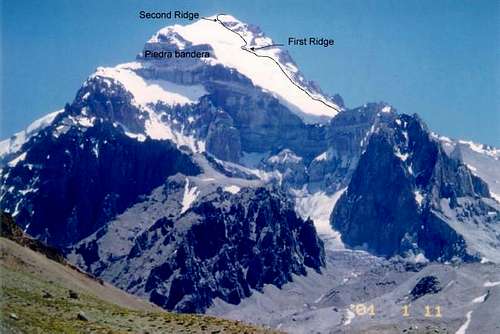
Option 2:  Climb a more technical route on Aconcagua and summit before the rest arrive.  I thought about this but the timing might not be great.  My responsibility for the climb is to establish our mule transportation and food for the entire group before they arrive.  I take that responsibility seriously but if I could take care of most of those details before I arrive then I could climb on the hill until they arrive.  One route that piques my interest is the Polish Glacier Direct route (thanks summit post):


That route would require about 10-12 days and give me plenty of time on the glacier and high up on the hill.  

There are a few drawbacks to this second option and one major advantage.  Drawback 1 (cost):  One downside is that the Aconcagua climbing permits are good for 20 days and an early climb followed by my family climb would require two permits (roughly $1300 in total).  The fees and logistics for the two climbs might make the two-climb push really hard on me both financially and logistically.  Drawback 2 (limited adventure):  Another drawback is that a more technical climb only allows me to see one mountain for the first four weeks of my trip.  Granted, I could easily retreat from Aconcagua afterwards and explore the CdP alone when my family takes off in early January but I might prefer to rest and relax in sunny Mendoza after climbing with my family.  Major Advantage (lower stress with family and friends):  A big climb before the others arrive cuts the stress on me during their climb.  I want to see the summit and they may not be as enthralled with the summit push as I am on summit day.  

Option 2 seems more appealing at this point but I need to figure out the logistics for mules, food, and transportation before I jump into another route - especially a more technical route that I would solo.  Additionally, the mountain may dictate the options more than my preference.  If unstable snow or poor ice conditions exist then a solo ascent up the Polish Glacier Direct would be foolish choice.  I expect a return trip no matter what the conditions so prudence trumps preference.

4.  Training going well.  Yep, not much to report.  I remain fit, fat (relatively speaking), and happy with no injuries to report and an overall good attitude that dominates my current situation.  I am so excited about the upcoming climbs that I can barely focus on much of anything else....but I do continue to chip away at the piles (megabytes perhaps?) of papers to write and grants to finish.  

Upcoming posts.....

  • I plan to detail my acclimatization formula based upon a ton of data from myself and others.  Expect some graphs and formulas to appear in the blog shortly.  
  • Gear check for the climbs to be laid out and explained in some detail.  Each climb requires slightly different gear.  Rainier requires a fast and light kit - not much to bring for a one-day push; Aconcagua requires a much more extensive kit for the potential two-climb expedition; finally, Everest requires a ton of gear but this year will be trimmed down substantially from last year.  
  • Lightening my load for all climbs will be my focus for the next few months.  I examined each piece of gear and started fixing, replacing, or retiring anything that does not serve multiple purposes.
More on these later.  Thanks for reading and feel free to post any opinions on my options or provide other options for Argentina.  I'm open to other ideas.  See you next week.

Wednesday, October 8, 2014

October 8th, 2014: I'm going climbing...soon.

Greetings,

The past week went by without much to note other than one major change - I get to climb soon.  Yeah!  We made plans to go to Portland, OR for Thanksgiving.  While there, I intend to take a day or so and climb Rainier.  The climb should give me some immediate feedback about my training preparation for Argentina.  I want to do a one-day push to the summit and see if I can sustain the effort.  The climb will be light and fast - alpine style.  If I can swing it, I want to bring my son but not if he prefers to spend more time with his cousins.  Kathy said she plans to spend her limited time with her family; thus, I might be on my own.  Here are a few other updates...

1.  Sleeping with my new mask.  Kathy continues to battle some bug while she prepares for her last triathlon of the 2014 season.  Her continued battle means that my acclimatization routine shifts from the tent to the mask.  My new mask is actually quite comfortable.  I wouldn't call it true comfort but it is not as bad as sleeping with the exercise mask.  Here is the mask in action:


Yep, I look a little weird but hey, I'm sleeping.  Who is gonna notice my strange looks other than my wife (who knows all my quirks already).

2.  Working on acclimatization index.  Many of you know that my work focuses on measurement.  I'm sure you all got the hints from my previous blog posts with countless figures showing my progress.  I wanted to figure out how well I was progressing with my training - particularly my acclimatization to different oxygen levels.  The progression needed to be expressed in terms of oxygen level (the predictor) with spO2, HR, and power (in Watts) as the outcome.  Some combination of the three outcome measures ought to communicate the extent to which I can accommodate the hypoxic stress.  Here is what I have come up with so far.  Feel free to comment on the blog if you have any other ideas.

As oxygen levels decrease from 20.9% (normoxia at sea-level), I should see a decrease in spO2 and power along with an increase in HR.  Thus, oxygen level is directly proportional to the two former and inversely proportional to HR:

O2% : spO2 + power + 1/HR

The additivity of these three components, however, is not clear to me and certainly not clear in the literature.  If I simply add them then the more variable components will be far more influential than the others.  Consider the simple problem of figuring out BMI (wt in kg / height in (squared)).  If your height does not change then all changes in BMI are attributable to only your changes in weight.   Thus, I need to weigh these three components in a logical way that does not favor one over the others - unless, of course, I wish to weight them unevenly.

Expect a full post on this topic shortly.

3.  Training...training...and more training.  I keep on training with the hope of being stronger this year than last year.  Last year's preparation was not terrible but I think I could gain a bit in fitness and, in particular, fitness at altitude.  Why not? Push harder and stay healthy seems like a good plan.  Preparation for a climb is one thing I can control.  Each day of the week offers me a different amount of freedom to train.  Here is what my cumulative weeks look like since I began training again in June 2014:


Each week during this second phase, I started increasing my training altitude (staring at 10,000 ft or 3050 m and slowly moving up to 20,250 feet or 6170 m)  So far, I logged 341 hours and expect to have almost 1000 hours before I push off for Nepal in early May.  Here is where I am in the process:


4.  Fat is where its at.  Despite all the training, I successfully maintained my weight at 175 lbs (79.4 kg) and intend to stay at that weight for the duration of my training.  Last year I struggled to get my weight back up after I lost a ton during my intense training.  I learned from my mistakes and decided to back off the intensity a bit and focus more on hypoxic training earlier to reduce the intensity of my workouts.  The net result of this change is that I am equally fit but now I maintain a little expendable weight that I am sure to shed during the first week at high altitude.  Beer and chips are now a staple in my daily diet.

That is about it.  More news to come shortly as I prepare for my climb on Rainier and then onto Aconcagua.  See you soon and thanks for following.