Sunday, February 25, 2018

42 Days Remain: Gear sort starting with me feet...

Welcome back to my adventure.  Starting today, I intend to provide more details about my gear and trip preparation.  Believe it or not, these posts help me organize my thinking about the climb.  Nothing helps me more than to review my gear and climbing plan.  Over the next few weeks, I plan to cover both topics - first my gear - and to post about gear relevant to each of the major body parts starting with my feet and ending with my head.   Along the trip up north through my body, you will learn about the gear I plan to take and when I plan to use it.  Brendan (my climbing buddy) and I spent some time organizing a Google sheet with all our gear.  Care to see the entire list?  Well, here it is.  We have many items on our list and some may end up staying home.  Until we finalize the list, expect it to change routinely until we depart.

My Foot Gear

Travel footwear from VA to Chinese Base Camp (CBC):  My trusted flip-flops.  These OluKai sandals (and their ancestors before them) traveled the world with me.  
I may replace this pair with a relatively new pair.  Nah....
CBC to Interim Camp and perhaps Advanced Base Camp (ABC):  Approach shoes.  I intend to either use my GoLite approach shoes - the same I wore to the summit of Aconcagua - or a new pair of Addidas trail running shoes if they fit and I can break them in before I leave.  Bad idea to break in new shoes on a big climb.  Blisters just don't heal at 6000m (20,000 feet) and above.

These GoLite approach shoes are comfortable but they have seen better days.  I ran them through 3 or 4 washing machine cycles to finally rinse the dirt off.  They might not be up for the journey.  I might use these Addidas trail runners instead.  

No, I don't have them yet.  They are en route from Moosejaw.com (don't ask).  

Advanced Base Camp and above:  Mountaineering boots.  I have a nice pair of La Sportiva Olympus Mons.  Right now, they are drying out from today's workout but I can give you a quick glimpse of the outer shells and liners - they both stink from sweat but I can spare a second to take a picture and then run them back into the gym where they can stink up that place and spare my office. 

The outer boot is to the left and the liner is on the right.  I intend to wear these for long stretches - not the outer boots unless I am climbing but the liners.  Those liners are comfortable.  I might even say they are as comfortable as bedroom slippers now.  

Against my skin:  I wear socks of course.  Well, actually, "of course" should not be taken for granted.  I know several people who never wear socks - even when climbing on glaciers.  They hate 'em.  I don't mind socks if I must wear closed toe shoes.  Here is an assortment of socks I plan to bring.  I intend to bring several pairs of some and only one pair of others.  

The leftmost pair of socks are my night time socks.  I put these over my feet with a healthy dose of foot powder to dry out my feet.  Nothing worse than trench foot when climbing.  Big thick wool mountaineering socks with Gold Bond Maximum Strength foot power does the trick every night.  The gray pair next to my mountaineering socks are my everyday climbing socks.  REI makes a great mid-weight sock that holds up over years.  I like these and they treat my feet well.  Even better for my feet for long days are two pairs of socks on the right - my compression socks.  The colorful pair are great but have probably seen better days.  The black pair are relatively new and will serve me well on Everest.  These compression socks help my feet by squeezing them all day.  I do get blisters from them on occasion so I intend to wear my newfound love - the vapor barrier sock (aka plastic bags) on my feet between the skin and the sock.  These bags inhibit blistering and also keep my feet from sweating too much.  Well, at least that is the plan.  So far, the bags just make my feet sweat buckets.  

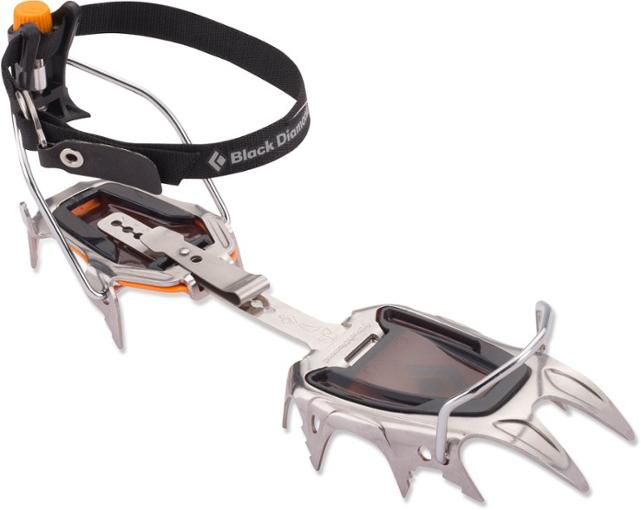
Climbing gear for my feet:  Crampons.  I like the Black Diamond Sabertooth Pro model but had some problems with them in 2015.  The heel piece broke unexpectedly after light use.  I brought only one pair to Everest that year and had to beg a few folks at basecamp for some spare parts.  This year, I have two pairs with multiple spare parts.  I have no intention of jeopardizing my climb because a little piece of plastic fails.  Here are my older pair:

You can see the heel pieces are different than the typical model that has a micro-adjustable skimpy heel piece as seen in the BD advertisement:
Black Diamond Sabretooth Pro Crampons - Pair Polished
The heel piece broke in my "old" pair so I have an improvised replacement and then I have a relatively new pair for both use and parts.  

Walking around camps (ABC and below):  REI down booties.  Oh yeah...these babies have seen it all and lived to tell about the adventures.  I love these down booties.  They are rugged and inexpensive.  My only gripe (and it is a minor one) is that my mountaineering socks are so bulky that they tend to squish my feet when I have my socks on when wearing my booties.  Next time, I plan to purchase a pair about 3 sizes too big for my feet.  Here are my friends:

Yeah, sure they look a little shaggy but these booties are warm.  You cannot go wrong with down booties.  REI makes a fine pair.

I am sure there are other things that I omitted in this post.  Sure, I have a ton of blister bandages and antibiotic creme that comes in handy but those things are not terribly unique to climbing Everest.  So there you have it!  My footwear gear collectively weighs about 4.5 kg or about 10 lbs.  I do not plan to lug all that weight up to the summit.  Some of these items remain at CBC while others accompany me for most of the climb (i.e., my mountaineering boots and socks).  

Thanks for following along.  Next post...what I wear on my legs.  Oooh, I know you can't wait.  See you in a few days.

Tuesday, February 20, 2018

47 Days Remain: Hypoxic sleeping....in a tent...indoors.

As promised, I am going to take you on a tour of my hypoxic sleeping setup and routine.  Here is my tent:


Inside the tent, I have all the luxuries including a fingertip pulse oximeter (for measuring my spO2 in the morning), an oxygen meter (for measuring the ambient oxygen level), toilet paper (for blowing my constantly running nose throughout the night), heart rate chest strap (for measuring my morning heart rate variability or HRV), Nalgene bottle (to quench my thirst through the night), comfortable pillow, and snacks (for obvious reasons).  All of these items fit snugly along with my upper body in the tent.  

Every night, I go to sleep between 8 and 9pm and plan for at least 8 contiguous hours of sleep.  Well, I say plan because I rarely sleep soundly for 8 hours.  Often, I wake up every other hour to drink some water or pee.  A side note for the latter activity might be necessary to explain how I stay in the tent for at least 8 hours.  Peeing requires a bottle.  I'll leave the gory details to your imagination.

My Hypoxico units sit along the wall in my exercise room (adjacent to my bedroom).  I ran the hoses through the wall so that I could keep the units away from the bedroom and in a cooler location.  Also, these units generate a ton of heat when they run overnight.  Locating them one room away allows me to have a sound night sleep without the additional heat and noise.  Here are the units:


See the hose that runs from the right-most unit?  That hose runs through the wall and into my bedroom.  These units strip the oxygen from the room air and pump that oxygen-depleted air into my tent.  The units have setting numbers that do not correspond exactly to the oxygen percent or any other value that makes sense.  I found that the units could loosely be calibrated by simply tracking the settings and plotting those settings to the observed oxygen percentage inside the tent.  Below is a snapshot of that calibration:


You'll note that the variability of the oxygen percentage varies quite a bit for each setting value.  I noticed this variability the more I observed the correspondence between these two variables.  Perhaps a more interpretable figure is the one that shows the relationship between the unit settings and the simulated oxygen levels (in Feet):


I have a few more setting units left on the scale to go but you can see clearly that my sleeping altitude is now about as high as these Hypoxico machines go.  What do these values mean in terms of my adaptation?  Well....they make it tough on my body for sure.  For those of you with extensive medical training, avert thy eyes.  You might get a shock from some of the numbers.  Fear not!  I am alive and doing quite well.  Here are spO2 values for each of the unit settings:

Yeah, some days are harder than others.  You can see that my spO2 drops with each successive value on the Hypoxico unit.  Over time, however, I tend to acclimatize to the oxygen levels and my spO2 improves.  How much does it improve?  Not enough to keep me out of the emergency room for those who know what these numbers mean.  A healthy person has an spO2 in the upper 90 percent range (I measure about 99% at sea level).  On setting 5 (as indicated in the figure above) using the high altitude adapter on full, I have a median spO2 of about 84%.  Contrast that number with my median spO2 of 71 on setting 6.5 with the adapter on full.   You can see that the response to the oxygen depletion is quite dramatic.  On about the 4th or 5th day of sleeping at each setting, I typically wake up with higher spO2 values and feel great; the first days on each setting can be quite rough.  So I feel an improvement even though I cannot observe that improvement by my spO2 values.  

All of these figures fail to tell the real story.  I need to explain what I am doing.  Here is a snapshot of my hypoxic acclimatization process.  I began my hypoxic sleep training in earnest on January 8th, 2018 by setting my Hypoxico unit to "9" (without the high altitude adapter) and sleeping blissfully for 9 hours.  NOTE:  I actually began sleeping in the tent on July 23rd, 2017 when I returned from a wonderful trip to Ireland.  OK, back to my "earnest" training. Setting 9 resulted in a oxygen concentration in the tent air of 13.6% or an equivalent altitude of 11,100 feet (3383m).  My spO2 in the morning was 88% or good enough to land me into the emergency room for most normal people.  Most of you realize I am not normal so that hospital trip would be a waste.  After about 5 days, I changed the unit setting by 0.5 to simulate a slightly higher altitude.  Each increase leads to a slight decrease in my spO2 (see figure above for some idea about how much change I observe).  

By sleeping every night at a simulated altitude, I increase my red blood cell count and potentially increase the oxygen carrying capacity of those red blood cells (by increasing the hemoglobin).  There are some conflicting views on the effectiveness of this process but I assure the most ardent skeptic that there is no way I could trek to Everest Basecamp in 2 days had it not been for the hypoxic sleep training I did in 2015.

Hopefully these tidbits provided you with some glimpse into one aspect of my training routine - my hypoxic sleep training.  During my next "rest day," I intend to describe some of my gear - starting with my feet.  With 47 days left, I have approximately 11 more full rest days to report on my preparation.  My sinus infection is now gone and I feel great.  With 43 days remaining, you will learn what I plan to wear on my feet.  Each successive post focuses on another part of my body's gear until I end with my head.  So, stay tuned for a foot to head detail of my gear.  

Thanks for following my adventure.

Friday, February 16, 2018

51 Days Remain: Rest days are not always restful

As promised, today's post includes multimedia amusement.  I recorded some video (unedited but brief) documenting what I do on a regular rest day.  Some of what I documented is my usual routine (movement prep, core, and stretching) whereas other bits are typical of my rest days.  Since today is a rest day, you now have a good idea about what I do during my 74 minutes of training.  On these rest days, I don't run, lift, or do any strenuous cardio training.  Instead, I focus on recovery and do a little hypoxic training so my brain is ready for the strange sensation of exerting an effort with little oxygen.  So, let me walk you through the videos.

First, I begin my day - every day in fact - with movement prep(aration).  The objective with these exercises is to warm up my body and get ready for the real deal.  Movement prep is every bit as important as any other aspect of my training.  Here I am demonstrating a typical movement prep routine:


Once my body is ready for more strenuous activity, I do my core exercise routine.  My back is rather fragile.  Too many years of skiing and training without proper care left my back susceptible to all sorts of nasty things...including sciatica (not recommended at all).  So my core routine varies from day-to-day but this one is a typical one when I just need to do it!


On a typical workout day, I follow up the core workout with a strength or resistance training routine.  I use the same tabata timer as I used in the video above but I do legs on the 1st and 3rd days of my 3 days on, 1 day off cycles; on the middle or 2nd day of the 3 day on cycle, I lift with my upper body.  Since today is a rest day, I didn't lift.  Later, I intend to take some video of my lifting routines but today I don't lift.  Also, once I am done with movement prep, core, and lifting, I typically run outdoors.  My runs are short but often high intensity so I can feel a little discomfort but also spare my knees of the added pain and suffering they don't deserve.

My rest day includes hypoxic training.  I provide a quick overview of my approach during the following video:


That elliptical workout often ends with me gasping for breath.  See...


Oh, but wait; there is more!  Once I finish my huge 10 minute workout on the elliptical, I then make a quick transition (note, I don't put on cycling shorts when I move from the elliptical to the bike - too long for too little gain).  


Finishing off the bike workout (again, another whopping 10 minutes), I stumble off the bike....


Now that I am done with the bulk of my day off, I finally get to stretch my muscles and gear up for the rest of my day....of work.  Ah, but first, I stretch:

My rest days do not consist solely of rest.  These are active rest days.  Some people do not take rest days when they are training for endurance events.  Many people find that rest days leave them flat.  Complete rest days make me feel flat and unmotivated.  I found that if I skipped the rest days to fully recover, I soon burned out and lost interest in training.  Striking a balance between too restful and not restful enough requires fine tuning on every athlete's part.  

Thanks again for following me during my preparation.  I realize you have plenty of other distractions on the internet and appreciate the fact that you distract yourself with my ramblings.  My next post will take you for a tour of my sleeping setup so you can see how my hypoxic sleep training unfolds every night.  See you in 4 days....

Tuesday, February 13, 2018

55 days to go: Three random and recurrent thoughts

Well...actually 54 days now.  Time sure is flying by.  I am chomping at the bit to head off but a few more things remain for me to sort out.  Below are three randomly recurring thoughts from the past few days.

1.  No matter how fit or prepare I am for these expeditions, there is always something that sneaks up and bites me.  That something is likely to be my sinuses.  I get sinus infections about 3 to 4 times each year.  The only year I successfully avoided them was when I prepared for my marathon swims.  For some odd reason, I seem to be able to fight them off when I am swimming every day for many hours.  Right now, I have a raging sinus infection.  Hopefully this one is the last infection I get before I leave.

2.  Training my brain is probably more important than training my body.  I spent the past 208 days training hard for this climb.  What I gained from it was more than just physical fitness; I gained mental fitness to help me overcome those points in the climb when I really need to dig deep.  My recent training days consist more of higher intensity training and less long, moderate slogs.  These higher intensity days test my mental resolve but no more so than the long "Summit Saturdays" I spent over the past few months.  I am ready mentally and know I am fit physically for any challenge.  The only problem...I have 53 more days until I depart.  My objective now is to stay healthy and refine any training to be ready for most if not all the mountain has to offer.

3.  Days off are just as important as days of training.  I am learning in my 5th decade that rest is just as important as exercise (and diet).  Combined, these facets of training offer me the most in preparation for this climb.  I take the rest when I schedule it and when my body seems to need more.  My recent sinus infection could be traced back almost two weeks ago (65 days remaining or 11 days ago) when my HRV readings started to indicate that my body was not fully recovering. Had I rested fully then, I might not be fighting this infection today.  Perhaps.  Maybe I am not that disciplined but I do plan to be more judicious about my rest moving forward.

I leave you once again with just a few tidbits of what inhabits my head these days.  All is well - despite feeling exhausted from this infection.  Over the next few weeks, I plan to do more strength training and maintaining my already strong aerobic base.  Next update (on Friday) will include some video of what I actually do on most of my workout days; come back and check them out.  Remember....

Work + Rest = Success!

Thanks for following.

Thursday, February 8, 2018

59 days left: Listening to my HRV and resting when necessary

Well, the Super Bowl ended with great fanfare.  We enjoyed both the game and the outcome.  Sorry to you Patriot fans but those Eagles fans needed the taste of victory - for once.  I sit here on Tuesday evening nursing my weary body after another unplanned rest day.  Why unplanned?  I decided to stick closely to the recommendations my body makes as I continue to prepare for this climb.  The training routine I planned to implement was both ambitious and flexible.  Thus, I continually strive to push myself with built-in regular rest time every 4th day.  Throughout the entire training cycle, I monitor my recovery by checking my heart rate variability (HRV) every morning.  

How do I measure HRV?

Every morning, before I do anything, I don a chest strap heart rate monitor (transmitter) and record my heart rate via two apps.  Why two?  I use two to corroborate this important measure to ensure that no oddity in either the software or in the algorithm interferes with my recovery or training.  These days I use hrv4training and EliteHRV.  Both produce fairly dependable results but there are some slight differences.  For one, the EliteHRV app provides guidance on breathing rate and alerts me when there are too many artifacts for the reading to be useful - something I wish the hrv4training app provided.  Despite these differences, I found the ratings to correlate highly (r > .95) and most mornings they offer me similar suggestions with respect to training (to train, to go hard, to cut back, or to rest).  So, once I take these recordings, what do I make of the numbers?  Well....read on!

HRV in a nutshell

The basic idea behind HRV is that our hearts beat from two mechanisms - the sympathetic (when you exercise, your heart rate increases due to stress load) and the parasympathetic (when you rest, your heart beats in the background to supply your body with needed oxygen).  These two mechanisms often indicate some level of continued stress your body must accommodate before it recovers.  Let's look at heart rate to give you a better idea of what I am talking about.  Thanks to the internet, we have tons of images that display the effect.  The image below came from the ithlete website (one of many HRV programs available for download and used on phones and tablets).  Each heart beat takes place at a certain time:

The heart rate "trace" above shows the different electrocardiogram or ECG signal patterns represented by the P, Q, R, S, and T signals in the overall heart beat wave.  We are interested in the R or peak waves and more specifically in the time between each R signal.  A beating heart that is stressed will have a consistent R-R interval or a low variability for the time between R signals.  That low variability is a sign that either 1) you are under stress and your sympathetic nervous system control of your heart is high or 2) you are in a state of active recovery and your parasympathetic nervous system is not contributing much to your overall heart rhythm.  Either of these two outcomes is not good.  Low HRV predicts mortality - among other things - and often is an early warning sign for overtraining.  "Cardiovascular autonomic balance as measured by HRV may be considered as a valid sign of short-term but not long-term fatigue."  Thus, we want our sympathetic and parasympathetic nervous systems to be in balance while we recover and, as a result, our HRV should be relatively high.  

How high do we want HRV?

HRV is a relative measure that must be "calibrated" to every person.  One person's values do not relate at all to another person's values.  Each of us needs to record several days to get an idea of trends between days and over time.  High values or rather relatively high values are what we wish to see to ensure that we have that balance between the sympathetic and parasympathetic nervous system activity - all indicative of proper recovery.  So high is a relative term.  Over the past month, my HRV average was 75 (a standardized value obtained from the natural log of the Root Mean Square of Successive Differences in R-R intervals - yes, very technical but the numbers range from 0 to 100 with higher being "better").  Today, my HRV was 78 and both apps indicated that I was "good to go" even though today is my planned rest day.  Below is a graph of my R-R intervals this morning:

And the figure below shows my weekly "Readiness" trend.  As you can see, the bars tell me that I needed to rest and I did.  I'm being a good boy.


Not all days are great.  Yesterday, my HRV was 84 and was strongly influenced by more parasympathetic activity than sympathetic activity - an imbalance.  Both apps told me to rest yesterday and I did rest to a degree.  I worked out "lightly" compared to the 5 hour day I had planned.  Thus, high is not always the best.  Balance is what we aim for and often that balance results in higher HRV scores.

Does HRV work when sleeping at simulated altitude?

We don't know.  I certainly don't know.  There are no systematic studies on the use of HRV with hypoxic sleep training.  I found to date that HRV corresponds well to my overall fatigue (perceived level of fatigue in the morning) and often my HRV scores are affected by two things - my rate of respiration and any abrupt changes in simulated sleep altitude.  Let me address each in turn.

Respiration rate greatly influences HRV scores.  If I pant heavily when I wake up, I will have abnormally altered HRV scores - sometimes elevated but often suppressed.  Calm, regulated breathing at about 6-8 breaths per minute result in optimal HRV scores.  Thus, if I have a huge change in my simulated sleep altitude, I often wake up breathing in more rapid, shallower breaths that result in lower HRV scores.  Breathing rate is extremely important to optimal HRV recordings.

Simulated altitude via the Hypoxico unit appears to alter my HRV moderately but not to the point where I can no longer use HRV to monitor my recovery.  If I have a huge increase in simulated altitude, I find that it is difficult for me to disentangle recovery from hypoxic stress.  One way around that conundrum is that I often increase my altitude on rest days where I know my body will not be stressed that day due to training and almost all the HRV changes would be attributable to oxygen changes.  I also need to take into consideration the combination of training stress (as measured by both intensity and duration) and hypoxic stress (as measured by relative oxygen saturation in the tent and morning spO2 levels upon waking) to fully appreciate the HRV changes on days when I do train and do sleep at very high altitudes (low oxygen levels).  

To give you a better idea of the complexity, consider today.  I woke up at 10.3% O2 or a simulated level of 18,500 feet or 5750m and I have been sleeping at this altitude setting for 5 days.  Usually, 5 days is enough for me to get "used" to the hypoxia and I increase the setting.  Since I had to take a few days off this week to fully recover, I decided to keep the level consistent and measure my HRV today after a relatively restful day - not complete rest mind you.  Once I post this material to my blog, I have about an hour of light training and then I'm off for rest of the day where I will sit in meetings, rest, and recover.  Tomorrow, I intend to wake up at about 9.7% or roughly 20,000 feet or 6200m (by increasing the Hypoxico unit from 6.5 to 7 with the high altitude adapter on full) and workout for about 4.5 hours.  That increase in simulated altitude alone will push my HRV lower but hopefully not enough to warrant a rest day after today's recovery day.  We shall see....

In short....

I use HRV now to monitor my rest and recovery.  The research to date shows some promise but I realize that the application of this tool cannot be done in isolation of other factors.  Hydration, nutrition, stress, breathing, and sleep affect HRV readings and often in ways that I cannot understand - at least not yet.  HRV helped me to rest when I normally would push through the fatigue.  Work + Rest = Success.  I have no problem with the "Work" part of the equation but the "Rest" part eluded me for some time; HRV seems to help so far.  

Expect more updates regarding my progress, recovery, and overall preparation.  Thanks for following.  Hope you found this material thought-provoking.

Sunday, February 4, 2018

63 days left - Super Bowl Sunday and some thoughts about excellence


What makes a person excellent at their craft?  Countless articles, books, movies, and such try to convince consumers that there are simple rules to success.  Take one event as a microcosm for success - the Super Bowl.  Tonight, the New England Patriots take on the Philadelphia Eagles for one of the most watched events on television per capita (worldwide).  Don't believe me?  Here are the numbers (all rounded for simplicity):

Top Event:  Cricket World Cup match between India and Pakistan (2015) had 1 billion viewers.  If we assumed that only those two countries and the host country (Australia) were interested in the event, we have a 1.5 billion people.  Now that seems a bit of a stretch.  We know that 14 teams qualified and presumably people from those 14 nations would be interested in the outcome of that seemingly critical match leaving us with 1.9 billion or roughly 53% of the interested parties watching.  Cricket appears to be more popular than any American could ever imagine.


Runner Up:  World Cup Final in Rio de Janeiro (2014) had 3 billion viewers.  Assuming that the world was interested in this event (given that it is called the "World Cup"), we can assume that the 3 billion came from the world's 7.6 billion for an estimated 39% of the total world population.  Not a bad showing world!


Super Bowl (last year):  112 million people in the US watched the game last year and we have 324 million viewers available giving us a 35% viewership per capita.


I don't expect it to be a good game but there is plenty we can all learn from the game and the two teams' preparation/execution.  Specifically, what makes a winning organization different than a...well...an organization that fails to win?  Mountaineering expeditions share many of the same attributes as these professional organizations.  The players prepare, anticipate and plan for as much of the game as could be expected, and they rest prior to the game.  The coaches prepare the players but also make decisions during the game to help the players be their best while exploiting their opponents weaknesses.  We mountaineers do the same as these players and organizations but the game is slightly different; the player, the opponent, and the decision-makers are one in the same - me.  So, what can I learn from these organizations to make me more successful?

1.  Don't follow the leader - find out what works for you.  I learned this the hard way many years ago when I tried to emulate elite athletes and their training programs.  They had extreme routines that I simply could not adhere to and, as a result, often felt like a failure.  Slowly, throughout the process, I learned that I had to listen to my own body and build up gradually.  What those elite athletes didn't tell me (us) is that they were like me at one point too and they didn't start off with such extreme routines.

2.  Learn to rest.  Stress + Rest = Success.  It is important to develop a workout routine and stick to it to the best of your ability BUT it is vitally important to rest.  All the work you put into your body only results in success if you allow your body to recover.  Most endurance athletes over-train and eventually burn out.  If you learn to rest when you need it, you will be ready to take on the next workout and make even greater gains.

3.  Immerse yourself into your craft.  There is no shortage of tales where the "excellent" describe a life focused on their craft early on.  These peak performers read everything, they talk to others about their insights, they test these insights empirically without reliance on authority or weak evidence.  By immersing yourself, you learn what others may refuse to learn.  Be better by reading, thinking, and testing.

So if you are lucky enough to live in an area where the game can be watched with relative ease, I suggest you think of these three things.  My suspicion is that the team that creates their own formula for success, shows up rested and focused, and studied diligently well before game time will be the victor.  Oh yeah, I also suspect that the team with Tom Brady will win....a non-trivial factor.

Enjoy the day and see you on my next day off.  By the way, my friend Jane asked about my workouts.  If you care to see how I am faring, check out the Google Sheet where I store scheduled and actual workouts.  You'll see that I took the past two days off due to unreasonably low HRV scores.  See?  I listen to my own advice.  Thanks for following.

Wednesday, January 31, 2018

67 days and counting: Four rules for training specifics to eliminate surprises

Another 3 days down and I am resting again - this time I really needed the rest.  Over the past few weeks, I started to focus on training for very specific instances where most mountaineers struggle.  We all struggle.  If you found the time to watch Adrian Ballinger and Cory Richards ascend Everest (from the Tibet side) without oxygen, you will see that they both struggled.  Climbing without oxygen that high is a huge feat - not one that I wish to accomplish due to the fact that I have too much invested in my brain already and I make my living by thinking.  That aside, those two expert mountaineers struggled with parts of the climb.  The more we prepare ourselves ahead of time for those struggles, the less likely they will affect us.  Sure, these climbs might still affect us or we might overlook something and get bitten by that oddity but nothing beats preparation to eliminate surprises.  I prepare for any adventure the same way...by following these four simple rules:

1.  Focus on the little things:  Everyone seems to focus on the big aspects of an adventure.  We need gear, fitness, and such but it is often the little things - often routine things - that interfere with our success.  Many forget to train themselves to go to the bathroom without making a mess, to change clothes quickly without much light to help guide the way, to organize your gear so everything can be found easily, and to eliminate any obstacle that interferes with optimal performance.  I try to train for all these little things (and many more) while at home.  I create checklists that I affix to the inside of my bags to eliminate any cognitive load while packing between camp sites.  These small steps help me immerse myself in the environment well before I even step on the mountain.

2.  Prepare for every scenario:  In most adventure sports, the odd scenarios are the ones that are most dangerous.  I try to the best of my abilities to prepare for both the good and the bad.  What happens if....and I think of contingency plans.  As Yvon Chouinard (the founder of Patagonia) said "[t]he word adventure has gotten overused.  For me, when everything goes wrong - that's when adventure starts."  We can all prepare a bit for the adventure though.  If we let everything unfold without much preparation, then we might find ourselves in adventures where and when none should exist.  


3.  Focus on the process - not the outcome:  I find more enlightenment in the process and experience of the outdoors and of adventure rather than the attainment of some goal within that environment.  You may differ from me but I think most of us who go outside, stress ourselves, and come away wanting more are those who enjoy the process.  I like the stress.  I like the preparation.  I like the discomfort.  I embrace it all.   Each of my adventures includes all and more but I find the most memorable aspects of every adventure are those that involve the struggle - not the culmination of the effort.  Sure, I celebrate the end but I live in the moment and enjoy every step, stroke, or surge forward.

4.  Eliminate surprises:  Most surprises come from inside - not outside of us.  If you know yourself and know how you will fare in every situation, you can both prepare yourself but more importantly you can prepare your mind.  I try to eliminate surprises to the best of my ability by experiencing the stress and strain of every adventure BEFORE I depart.  I start from my feet and move upward to the top of my head.  What can my feet withstand?  Apparently not much these days.  Then, my legs; how do they fare after long days?  Can they withstand more stress after 3 or 4 days of hard slogging?  Eventually I move up to my head.  What does it feel like to be truly tired?  How does it feel to be exhausted, dehydrated, malnourished, or spent (all combined)?  I like to feel and know how I react before I leave so I can also learn how to prevent these situations from occurring.  It is one thing to say that you know how you feel but it is another to say that I both know how I feel in those situations and I know how important it is for me to prevent them (and here is how...).  

These four steps served me well over the past few decades.  Thanks for following my adventures.  Hope you have a lovely day.

Saturday, January 27, 2018

Rest day today...so I figured I would post an update with 71 days left

My climbing partner - Brendan Madden - and I were chatting recently about immersing ourselves into the climb.  We both watch YouTube videos pertinent to the Tibet side Everest climb.  For those interested in seeing two that provide a ton of detail, we recommend Li-Lan Cheng's video and the Everest No Filter:  A SportsCenter Special video.  Both videos offer a clear glimpse of all the camps, terrain between camps, and general climbing conditions.  I think I speak for both of us when I say that watching these repeatedly gives us a wonderful vision of what we can expect.  

Speaking of expectations, we are dutifully documenting our gear and needs by camp throughout the climb.  I create checklists that I later print out to save me from having to remember or scramble for gear when I am least capable.  A simple checklist enables me to operate mindlessly on most of the climb.  Yes, you could say I am a planner but the best laid plans often go haywire...and that is when the adventure begins.  

Our plans include a rather rough sketch of our climb.  SummitClimb provides a detailed itinerary that merely gives climbers a general idea of the climbing routine.  We embellished that itinerary to give both of us an idea about the changes in altitude and potential equipment needs for each day.  Below are two figures that show how the climb progresses by altitude:

In feet for our American friends:
and in meters for our international (non-US) friends:

The difficult part of planning the climb is determining when the summit push occurs.  As I mentioned above, the itinerary is a rough sketch.  We have no idea if the mountain will allow us to climb on the day we aim to summit.   Instead, we have data to consult - the Himalayan Database.  Richard Salisbury and Elizabeth Hawley cobbled together records from thousands of climbs and climbers over the years.  The data are now available for all - thanks to the sponsorship by the American Alpine Club.

I read the data into my favorite statistics program (R) and plotted the days in May where successful summits occurred (on either side).  The results are quite surprising.  Below is a figure that represents the day in May (why May?  Because that is the most likely month to summit Everest).  


The figure shows that the mean summit day falls on May 21st (20.69 for those who are interested in minutiae).  That date - plus or minus 1 standard deviation (often represented as +/- SD) gives us an expected summit window from historical records (since 2000) of May 17th through May 25th.  Why did I restrict my search to 2000 and later?  The climbing structure for both sides differed over the years.  Each side's mountaineering oversight changed until the local authorities started implementing more of a standard routine at or about the year 2000.  Historians may differ on my cut-off but I am not producing this for historical purposes; I want to get a "best guess" on a summit window.  So, sometime in mid to late May, we might be fortunate enough to summit Everest.

Our planning and preparation continue.  We aim to winnow down our gear to what we "need" and when we might find it useful.  More on that process later.  Speaking of needs....I need to get my day going.  Rest days are not always restful!

Thanks for following.  Expect another update on my next rest day - this upcoming Wednesday (1/31/18).  See you soon.  Have a lovely weekend.


Tuesday, January 23, 2018

75 days to go and my feet are killing me

Sexy, huh?  Working out with me boots.
In 75 days, I will be in Kathmandu.  Between now and then, I need to figure out how to get my feet comfortable for long days in my mountaineering boots.  They are not happy.  My feet logged roughly 200 hours in my mountaineering boots already and I forecast at least another 200+ hours before they feel like bedroom slippers.  The problem is that my feet just don't like to be constrained.  I wear Olukai flip-flops daily - rain, shine, snow, sleet, hail...you name it, I wear 'em.  Mountaineering boots ain't flip-flops by any stretch of the imagination.  Moreover, as I get older, my feet get more sensitive to being bound by closed-toed shoes/boots.  

Fancy "vapor barrier socks"
After photo of my feet.
One method I used recently with great success is vapor barrier socks.  What are vapor barrier socks you ask?  Well, they are simply plastic shopping bags.  I put the bag on my bare skin foot like this (see image above to the right) and my sock over the bag.  What does this crazy method accomplish?  One thing is does is it makes my feet sweat like there is no tomorrow (see image above to the left).  I collect about 200-300ml of sweat in each foot bag.  Pretty disgusting I tell you.  Also, the bags eliminate friction so I protect my feet from blisters.  All of these outcomes are good. 
Sock over bag.
What it doesn't do is protect my feet from the odd pressures that come from wearing a form fitting boot.  My feet ache after about 2 hours - no matter what activity I perform.  Walking, hiking, elliptical, sitting, standing....all of these activities eventually end up killing my feet.  They just rebel after 2 hours.  So, I am trying a few things to fix the ache. 
 
Oh, just in case you wanted to see what my feet look like after 2 to 3 hours in the boots with bags and socks....feast your eyes on that sexy foot photo above.  My feet are soaked and they are not happy.  Yes, I could be a foot model.

My plans are to break in my boots completely before I head out.  I want to have all my gear fitted, comfortable, and ready to be used without any attention.  If I am ready, I should be able to put on my boots without seeing my feet - essentially by feel.  I want my lacing system to be pre-set so I don't need to think when I lace them.  The lacing needs to be flexible depending upon my foot swell and comfort - laced loose when climbing in the morning to allow blood circulation and then tighter upon descent.  These are typical lacing changes for all types of mountain adventures.  All of these changes, however, require me to have well-fitted boots that don't hurt my feet.  My current pair are the "best" for my feet but still my feet ache.  I wish I could climb in my Olukai's.  


 Today is my day off.  I have until February 12th to build up more of a load and then I start a little higher intensity training routine (nothing terribly intense though).  Feeling great....ready to go.  Wish my feet didn't ache.

More in about a week.  Thanks for following along.


Thursday, January 11, 2018

90 days left - where did the last 170 days go?

Greetings,

That momentum I thought I had for future posts went out the window as I wrapped up a busy semester.  Once the semester ended, I headed up to the Pacific Northwest (the states of Washington and Oregon in the US for those of you from far away).  I skied and skinned with my pals and they taught me a thing or two about youth (don't waste it).  Today (Tuesday) marked a milestone where I both began training again in earnest after skiing during the holidays.  Finally, I felt good enough to train after suffering from 3 sinus infections.  Ah...all is good now.  So, 90 more days until I will be in Kathmandu (as of January 9th).  Here is what I can offer as an update.

1.  I am physically fit to leave today.  So if I am fit already, why continue to train?  Over the next three months, I plan to lose a few pounds to make climbing a wee bit easier, break in some new(er) gear while staying fit, and implement a few training changes to put the finishing touches on what I believe is shaping up to be another great preparation.  I am fit to climb today but I have some minor details to iron out.

2.  I keep learning with each adventure.  My first Everest preparation focused a fair bit on training.  I found that fitness was only one aspect of alpinism and a very small part.  In preparation for my second Everest expedition, I focused more on hypoxic training AND fitness.  Together, these two approaches provided me with sufficient stamina to reach Everest basecamp in a day and a half (well short of the 5 days it took us in 2014).  Still, I thought I could do better.  For my third time (and final attempt), I am combining the two previous bits with another approach - get hardier.  I figure being fit, acclimatized, and hardy gives me the best shot of tolerating anything.

3.  Hardiness training comes easier than I thought.  Preparing for marathon swimming gave me insights into how training leads to better tolerance for extreme environments.  Specifically, I learned to tolerate cold water by simply immersing myself in cold water, cold air, and warming up naturally.  I now vary my diet, eat simple foods, and push myself to be uncomfortable.  Every day, I take cold showers to develop better cold tolerance.  These efforts are easy and enjoyable.  You can say what you want but after a while, I find comforts to be uncomfortable.

4.  Weight training takes priority over cardio training this time around.  I found that too much cardio training lead me to lose muscle mass.  Rather than push my time running, and working out on the elliptical and bike to build my cardiovascular fitness, I now focus more on weight training to maintain my strength.  I focus on legs more than upper body but I cannot let my upper body go to pot.  Upon my return from Everest, I have a month to recuperate and then I head back to Ireland for more marathon swimming in Cork (hi to my Cork Distance Week friends).  So, I hope to remain strong throughout the entire preparation.  

5.  My plans are shaping up.  I leave on April 5th for Kathmandu.  More details to follow.

Thanks for following along.