Yes, I am inside double digit days until my flight takes me to Kathmandu (KTM). Things are starting to get real. Yeah, they were always real but I now feel the time pressure. Today, I provide the last details about my gear - the stuff that covers my head, hands, and body. First, my hands....
Hand Gear
Each person must decide how to combat the cold and where to focus their attention in the effort. I find that my hands are the least affected by the cold. Well, actually, that is not true. My hands sweat almost constantly when I climb - even at high altitude. Sweating is deadly because wet hands lead to frozen gloves which, in turn, lead to frostbitten hands/fingers. Today, there is no excuse to have frostbitten hands because the gear technology is so advanced that we can eliminate most risks. The best way to eliminate frostbite risk is to have plenty of gloves/mittens so you never need to climb with wet ones. Here is my hand gear:
From the bottom right going clockwise, I displayed my hand gear according to weight. My trusted Mountain Hardwear light-duty gloves (bottom right) are my most versatile piece of gear. I cannot recall the model but they are no longer manufactured. After I wore my first pair, I went to the store and purchased 3 more pairs. Each pair lasts me about 3 seasons and I am on my last pair - tells you how long I have been using them. These gloves are light enough to keep my hands warm until about 20F (-7C) provided I am moving. I love these gloves, wear them for all winter climbs, and rely upon them to keep my hands from getting sopping wet with sweat. My guess is that I will wear these gloves from Chinese Basecamp (CBC) until probably Camp 1 - weather permitting. Next, I have my Helstra Heli Ski Gloves. These beasts are great for colder weather (for me at least). They keep my hands toasty warm from about 20F (-7C) to about 0F (-18C) and allow me to use my fingers. I can climb and ski with these in the most challenging conditions without much fear of my hands getting cold. When the air temperature warms up though, my hands tend to sweat a ton in these gloves. Thus, I probably will alternate early on between these gloves and my lighter Mountain Hardwear gloves. My Helstra gloves would be my cold weather hand gear - probably used between Advanced Base Camp (ABC) until at least the North Col (Camp 1) or even Camp 2. I prefer to have my fingers available while I climb so gloves are a priority for as long as possible. Once I get up higher than Camp 2, I intend to switch to my mitts. The first mitt (top row to the left) is my lightest mitts - the Norrona trollveggen dri PrimaLoft 400 long mittens. I love these mittens because they keep my hands dry and warm but do so without sacrificing too much in my hand dexterity. Typically, I wear these mitts when I finally get going on a long, high climb. I can easily maneuver my jumar and access all my gear without taking my mitts off when I wear these. My best guess - although I don't keep track of this detail - is that I would wear these mitts after I get a full head of steam past Camp 3. Before I put these on, I probably will wear my warm mitts - either my North Face Himalayan Mitt (center top row) or my beastly Outdoor Research Alti Mitt. The North Face mittens are decent for colder climes where I do not need much hand dexterity. I tend to favor slightly smaller mittens for the Himalayan mitts - I wear a medium in these whereas all my other hand gear is a large. The cold killer is definitely my OR Altis. These mittens keep my hands warm for all temperatures at or below -20F (-28C). I feel absolutely nothing but warm, coziness inside these mittens but they offer me almost no dexterity with my fingers; even my thumb feels somewhat restricted in these mittens.
As you can see, I have a hand protection progression with some redundancy. If a pair of my lighter gloves get wet, I must move to mittens while my gloves dry. Drying gear on the mountain can be a challenge but we have ways to hang our gear inside the tent while we sleep. With the heat coming from our bodies, we can dry most anything. Still, wet hand gear is a huge drag. I intend to dry all my gear almost daily - especially my hand gear.
Head Gear
A popular saying is "Cold hands, cold feet? Put a hat on." I abide by this saying without hesitation. Alan Arnette asked me what piece of equipment is my favorite and I knew exactly what to say: my watch cap (center top in picture below).
I wear this cap almost every minute I am on the mountain - even when sleeping. When it is warm, I wear my trusty visor (with wind leash to keep it attached to me at all times). Unless it is dark outside, I wear my Nativ glasses (with interchangeable lenses) as eye protection or if the weather really turns sour, I wear my Julbo Explorer Mountain Sunglasses. These glasses are great when the weather is uncooperative. I find that these glasses tend to fog in the heat so I only use them in windy, inclement weather. Yes, I do wear goggles too - Oakleys (not pictured) - but I find they fog up when I climb and I end up spending more time trying to clear them rather than focusing on the climb. The final pieces of my head gear are my buffs. On the left (picture above) is my daily light buff that serves two purposes: 1) keeps the sun off my face and offers some warmth and 2) keeps the dust from getting into my lungs during the approach. I intend to use this buff almost daily to keep my skin from getting too much sun and my lungs clear from the dust. The right most buff is my heavy duty one that replaced my balaclava. In years past, I would wear a mask during climbs that kept my face warm, however, the balaclava mask was unwieldy and often caused my glasses/goggles to constantly fog. I now use my thicker buff and find it almost never fogs my eye protection. Plus, the buff extends down to my chest to keep the cold from entering through my neck area in my summit suit or parka.
Full Body Gear
I have two pieces that cover my entire body. The first piece is a mid-layer (bottom in picture below) that goes between my base layer and my summit suit (top in picture below).
These two pieces are critical for my success. The summit suit is basically a down sleeping bag with legs and arms. When I put it on at home, I start sweating immediately and don't stop sweating until about an hour after I take it off. Seriously, this suit is HOT! The suit fits very well, has tons of pockets, and will keep me toasty warm from Camp 3 and higher. I even plan on sleeping in the suit when I reach the highest camp. No need for a sleeping bag when I wear it. What really seals the warm deal here is the mid-layer, farmer john suit that clings to my body like a second skin. That layer offers me just a little bit of added warmth and stops and "leaks" of air from hitting my skin and causing a chill.
Keeping warm when high up on a mountain requires this type of equipment. It is not the cold that really affects us but rather the altitude. When we are struggling to acclimatize to the low oxygen environment, our bodies shunt blood from our periphery to our core - hence, we tend to get frostbite in our hands and toes. The purpose of the equipment is to keep our hands and toes warm in spite of the poor, peripheral blood circulation. Additionally, a slow, gradual exposure to high altitude (and low oxygen) alleviates the blood restriction in our periphery. So preparation from both the gear and the acclimatization process protects us from frostbite.
There you have it! My gear list is now complete. Time to start packing. I will show you how all this gear goes into my two expedition bags. Pictures of packing come shortly. In the meantime, I have two other posts to share. My next post shows you the before and after of my training. I began training for this climb in mid-July after I returned from Cork Distance Week (a wonderful open-water swimming event held in Kinsale, Ireland). At the time, I weighed 198 lbs (90 kg) and now I weigh 176 lbs (80 kg). Yep, I lost a ton of weight. Moreover, I also gained a fair bit of muscle mass in my legs. Come see for yourself in my next post. After that post, I intend to test my Garmin InReach device by posting several tests on my blog. Feel free to check out the maps and such; don't hesitate to ask me questions. I intend to update everyone so that you can follow Brendan and me during our climb.
Thanks for following. Hope you found this material interesting. Be sure to note from the pictures we post how I use the gear I detailed in these post. Oh, one other thing. For those of you interested in learning about my sleep shift, I am doing well. Tonight (ahem, perhaps tomorrow is more appropriate) I go to sleep at 4am and wake at noon. If you are wondering how I am faring, I feel great. Nothing quite like starting a workout at midnight to really keep the spirits up! Thanks again for your interest and support. See you soon....
In April 2014, I attempted to climb Mt. Everest before an avalanche in the icefall claimed the lives of 18 Sherpa. A year later (May 2015), I returned to Mt. Everest only to witness a 7.8 earthquake while at camp 1. I am preparing to climb again in April 2018 but this blog is dedicated to my purposeful pursuits. Please be sure to check out the charities that I support and follow me on twitter (@pem725) or instagram (pem725).
Showing posts with label gear check. Show all posts
Tuesday, March 27, 2018
Tuesday, March 20, 2018
19 Days Remain: My torso gear and a quick update
Inside 3 weeks and I cannot keep still. The anticipation is just killing me. I have a few thousand things to do before I leave but those will be in my rear view mirror in short order. A few days ago, Alan Arnette asked me if I would like to be interviewed and I readily jumped at the opportunity. Alan chronicles Everest climbing every year and offers readers wonderful insights into the ground-level happenings on both sides. Aside from being a climber himself, he is also a delightful guy. We met several times in Kathmandu over the past few years and I always enjoyed chatting with him. Needless to say, I felt incredibly grateful that he would have any interest in me or my climb. If you are curious about his website, I encourage you to explore it. Also, feel free to donate to his cause for Alzheimer's research; he takes nothing from the donations and gives back to the world ten times over.
I resume my coverage of gear by moving ever so slowly up my body. Today, I discuss my torso gear. I discuss each article moving from my base layers outward. So, without further delay, here goes....
Base Layer
I rely on my X-Bionic base layer top for warmth and recovery.
This base layer is really tight but made of some stretchy wool - similar to most Merino wool tops but way warmer. I wear this for days on end against my skin without fainting from the smell. No kidding! These tops resist getting smelly. Brendan will thank me for wearing this instead of some technical shirt. Speaking of technical shirts, I do wear one every day but mostly when I am in my tent. These "tech" shirts get really smelly in a hurry. I wear them to give my warm base layers a break and let them air out. Also, I tend to run warm so wearing a short-sleeved shirt in the tent suits my internal body temperature.
I often bring about 5 or 6 of these tech shirts because they are light, take up no space when compressed, and get smelly quickly so they need to be either recycled or discarded in my bag of stinky clothing. I also wear them every day so I need to have a few changes while I climb. Many days when the temperature reaches 30F (2C) or higher, I wear these shirts and a light top so they are quite versatile.
Mid Layer
I typically wear one fleece on and off throughout every expedition. My fleece is really light - equivalent to a sweatshirt but much warmer when wet. I also wear a long-sleeved tech shirt as a mid-layer over my base layer to just add another layer of warmth. The tech shirt is something like the one pictured to the right. Nothing fancy but it fits the bill nicely when I need just a little more warmth without any additional weight. I also wear a puff down jacket as a mid-layer under my hard shell top. My puff jacket has no hood but is warm and light. Once wet, however, a puff jacket is useless so I try to use it only when I know I will either not sweat much or there is no chance of rain. On Everest, the likelihood of rain is remote at basecamp or above; below basecamp, however, rain can be a problem.
Outer Layer
Finally, we get to the most outer layer covering my torso. I rely heavily on my big parka. This jacket is so warm it can keep me toasty in the coldest temperatures. I wear this as soon as I get into camp after climbing all day, crawl under it when I sleep on cold nights, and lounge around in it at basecamp when I get a chill. Think of it as a sleeping bag with arms - not quite the coverage as my summit suit but it covers my torso and head nicely.
The other article I rely upon when climbing - almost daily - is my hard shell top. I purchased this top almost 8 years ago and patched it, resealed it, and tortured it for that entire duration. When I climb, I typically wear only the bare necessities under this top. I find a tighter, wind-stopping outer layer allows me to stay warm while I climb. Stopping for long periods requires more insulation so if you plan to climb with minimal layers, keep moving!
These are the few items I intend to take on my upcoming Everest expedition to cover my torso. Most of my choices come from many years sorting through gear that I found both useful and necessary. Each of these items fit those criteria and can be used under the conditions I expect to encounter on Everest this year.
I have two more areas of my body to cover - well, three. Over the next few days, I intend to cobble together more pictures of my head and hand wear. My final post on gear includes those articles that cover my entire body. There are not many articles of clothing that do that job but there is one in particular that I rely upon heavily for summit day. So stay tuned for more gear.
Thanks for following and a huge thanks to Alan Arnette for interviewing me for his blog.
I resume my coverage of gear by moving ever so slowly up my body. Today, I discuss my torso gear. I discuss each article moving from my base layers outward. So, without further delay, here goes....
Base Layer
I rely on my X-Bionic base layer top for warmth and recovery.
![]() |
| My favorite base layer - the X-Bionic top |
![]() |
| A typical tech shirt |
I often bring about 5 or 6 of these tech shirts because they are light, take up no space when compressed, and get smelly quickly so they need to be either recycled or discarded in my bag of stinky clothing. I also wear them every day so I need to have a few changes while I climb. Many days when the temperature reaches 30F (2C) or higher, I wear these shirts and a light top so they are quite versatile.
Mid Layer
![]() |
| Long-sleeved tech shirt |
![]() |
| My puff down jacket - used as a mid-layer or just as a light outer jacket |
Outer Layer
Finally, we get to the most outer layer covering my torso. I rely heavily on my big parka. This jacket is so warm it can keep me toasty in the coldest temperatures. I wear this as soon as I get into camp after climbing all day, crawl under it when I sleep on cold nights, and lounge around in it at basecamp when I get a chill. Think of it as a sleeping bag with arms - not quite the coverage as my summit suit but it covers my torso and head nicely.
![]() |
| My down parka |
The other article I rely upon when climbing - almost daily - is my hard shell top. I purchased this top almost 8 years ago and patched it, resealed it, and tortured it for that entire duration. When I climb, I typically wear only the bare necessities under this top. I find a tighter, wind-stopping outer layer allows me to stay warm while I climb. Stopping for long periods requires more insulation so if you plan to climb with minimal layers, keep moving!
![]() |
| My hard shell top |
I have two more areas of my body to cover - well, three. Over the next few days, I intend to cobble together more pictures of my head and hand wear. My final post on gear includes those articles that cover my entire body. There are not many articles of clothing that do that job but there is one in particular that I rely upon heavily for summit day. So stay tuned for more gear.
Thanks for following and a huge thanks to Alan Arnette for interviewing me for his blog.
Sunday, February 25, 2018
42 Days Remain: Gear sort starting with me feet...
Welcome back to my adventure. Starting today, I intend to provide more details about my gear and trip preparation. Believe it or not, these posts help me organize my thinking about the climb. Nothing helps me more than to review my gear and climbing plan. Over the next few weeks, I plan to cover both topics - first my gear - and to post about gear relevant to each of the major body parts starting with my feet and ending with my head. Along the trip up north through my body, you will learn about the gear I plan to take and when I plan to use it. Brendan (my climbing buddy) and I spent some time organizing a Google sheet with all our gear. Care to see the entire list? Well, here it is. We have many items on our list and some may end up staying home. Until we finalize the list, expect it to change routinely until we depart.
My Foot Gear
Travel footwear from VA to Chinese Base Camp (CBC): My trusted flip-flops. These OluKai sandals (and their ancestors before them) traveled the world with me.
I may replace this pair with a relatively new pair. Nah....
CBC to Interim Camp and perhaps Advanced Base Camp (ABC): Approach shoes. I intend to either use my GoLite approach shoes - the same I wore to the summit of Aconcagua - or a new pair of Addidas trail running shoes if they fit and I can break them in before I leave. Bad idea to break in new shoes on a big climb. Blisters just don't heal at 6000m (20,000 feet) and above.
These GoLite approach shoes are comfortable but they have seen better days. I ran them through 3 or 4 washing machine cycles to finally rinse the dirt off. They might not be up for the journey. I might use these Addidas trail runners instead.
The leftmost pair of socks are my night time socks. I put these over my feet with a healthy dose of foot powder to dry out my feet. Nothing worse than trench foot when climbing. Big thick wool mountaineering socks with Gold Bond Maximum Strength foot power does the trick every night. The gray pair next to my mountaineering socks are my everyday climbing socks. REI makes a great mid-weight sock that holds up over years. I like these and they treat my feet well. Even better for my feet for long days are two pairs of socks on the right - my compression socks. The colorful pair are great but have probably seen better days. The black pair are relatively new and will serve me well on Everest. These compression socks help my feet by squeezing them all day. I do get blisters from them on occasion so I intend to wear my newfound love - the vapor barrier sock (aka plastic bags) on my feet between the skin and the sock. These bags inhibit blistering and also keep my feet from sweating too much. Well, at least that is the plan. So far, the bags just make my feet sweat buckets.
CBC to Interim Camp and perhaps Advanced Base Camp (ABC): Approach shoes. I intend to either use my GoLite approach shoes - the same I wore to the summit of Aconcagua - or a new pair of Addidas trail running shoes if they fit and I can break them in before I leave. Bad idea to break in new shoes on a big climb. Blisters just don't heal at 6000m (20,000 feet) and above.
No, I don't have them yet. They are en route from Moosejaw.com (don't ask).
Advanced Base Camp and above: Mountaineering boots. I have a nice pair of La Sportiva Olympus Mons. Right now, they are drying out from today's workout but I can give you a quick glimpse of the outer shells and liners - they both stink from sweat but I can spare a second to take a picture and then run them back into the gym where they can stink up that place and spare my office.
The outer boot is to the left and the liner is on the right. I intend to wear these for long stretches - not the outer boots unless I am climbing but the liners. Those liners are comfortable. I might even say they are as comfortable as bedroom slippers now.
Against my skin: I wear socks of course. Well, actually, "of course" should not be taken for granted. I know several people who never wear socks - even when climbing on glaciers. They hate 'em. I don't mind socks if I must wear closed toe shoes. Here is an assortment of socks I plan to bring. I intend to bring several pairs of some and only one pair of others.
The leftmost pair of socks are my night time socks. I put these over my feet with a healthy dose of foot powder to dry out my feet. Nothing worse than trench foot when climbing. Big thick wool mountaineering socks with Gold Bond Maximum Strength foot power does the trick every night. The gray pair next to my mountaineering socks are my everyday climbing socks. REI makes a great mid-weight sock that holds up over years. I like these and they treat my feet well. Even better for my feet for long days are two pairs of socks on the right - my compression socks. The colorful pair are great but have probably seen better days. The black pair are relatively new and will serve me well on Everest. These compression socks help my feet by squeezing them all day. I do get blisters from them on occasion so I intend to wear my newfound love - the vapor barrier sock (aka plastic bags) on my feet between the skin and the sock. These bags inhibit blistering and also keep my feet from sweating too much. Well, at least that is the plan. So far, the bags just make my feet sweat buckets.
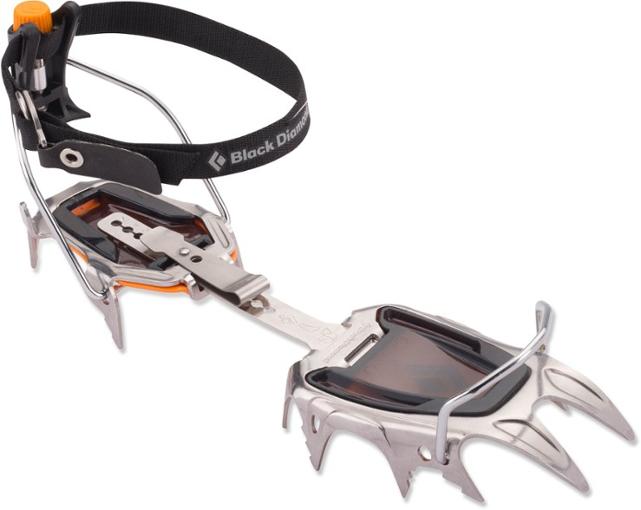
Climbing gear for my feet: Crampons. I like the Black Diamond Sabertooth Pro model but had some problems with them in 2015. The heel piece broke unexpectedly after light use. I brought only one pair to Everest that year and had to beg a few folks at basecamp for some spare parts. This year, I have two pairs with multiple spare parts. I have no intention of jeopardizing my climb because a little piece of plastic fails. Here are my older pair:
You can see the heel pieces are different than the typical model that has a micro-adjustable skimpy heel piece as seen in the BD advertisement:
The heel piece broke in my "old" pair so I have an improvised replacement and then I have a relatively new pair for both use and parts.
Walking around camps (ABC and below): REI down booties. Oh yeah...these babies have seen it all and lived to tell about the adventures. I love these down booties. They are rugged and inexpensive. My only gripe (and it is a minor one) is that my mountaineering socks are so bulky that they tend to squish my feet when I have my socks on when wearing my booties. Next time, I plan to purchase a pair about 3 sizes too big for my feet. Here are my friends:
Yeah, sure they look a little shaggy but these booties are warm. You cannot go wrong with down booties. REI makes a fine pair.
I am sure there are other things that I omitted in this post. Sure, I have a ton of blister bandages and antibiotic creme that comes in handy but those things are not terribly unique to climbing Everest. So there you have it! My footwear gear collectively weighs about 4.5 kg or about 10 lbs. I do not plan to lug all that weight up to the summit. Some of these items remain at CBC while others accompany me for most of the climb (i.e., my mountaineering boots and socks).
Thanks for following along. Next post...what I wear on my legs. Oooh, I know you can't wait. See you in a few days.
Subscribe to:
Comments (Atom)