We plan to be at the pub (downstairs @ the Auld Shebeen) at 4pm this Friday until they kick us out. Come on out and enjoy a few pints. Below is a link to an evite. Please RSVP so we can get a good headcount on the event.
Click this link ---> http://evite.me/WCrtx79Fje
I have a ton of pictures and plenty of stories to tell. You may come with questions, comments, criticisms, or just a thirst. I welcome all. Bring your family and friends; Mick, Dominic, and the rest of the staff welcome the business and I welcome the company.
Thanks again for all your support.

In April 2014, I attempted to climb Mt. Everest before an avalanche in the icefall claimed the lives of 18 Sherpa. A year later (May 2015), I returned to Mt. Everest only to witness a 7.8 earthquake while at camp 1. I am preparing to climb again in April 2018 but this blog is dedicated to my purposeful pursuits. Please be sure to check out the charities that I support and follow me on twitter (@pem725) or instagram (pem725).
Tuesday, May 5, 2015

Saturday, May 2, 2015
Current reflections on the past few weeks: Facts, fallacies, and myths
I begin my post-climb update with a few thoughts rather than a summary of the events. Most of you may already know the facts but few of us know the full story. My aim here is to arrest some of the fallacies or myths that appear from the media - a group who seem to thrive on sensational headlines and sordid tales of conflict. Not only do I have first-hand experience with some of the events (from Camp 1) but also I have first-hand experience with the media here in Nepal. Many of them are well-intentioned but they (or their editors) get carried away with stories that probably attract more readers. I sit in the Yak & Yeti right now, typing away on my computer, surrounded by more media members than climbers. The media continually probe for more content. Today, I present some content - perhaps the type that doesn't sell quite as well as their pieces. Permit me now to give you some of my reflections.
NOTE: I deliberately omitted any links to the articles I refer to below. My efforts here should not give these pieces more attention than they deserve.
Reflection 1. Bad intentions are rare but seem more prevalent from media reports. Many recent articles depict selfish individuals who pursue their own narcissitic goals at the expense of others. The anecdotes of these "bad actors" gain greater credibility when they come from western climbers calling out their fellow climbers. One article even quoted a multi-millionaire climber who said he felt sick - to the point of wanting to vomit - because his fellow expedition members expressed interest in climbing rather than helping the poor and needy in Nepal. Anecdotes like these only serve to increase the public's perception of climbers' bad intentions. There are no bad intentions based upon my seemingly endless conversations with climbers. There are competing goals and incomplete knowledge that appear as bad behaviors driven by bad intentions.
Before casting judgment on others, ask yourself why someone may act in a way that runs contrary to how you think he or she ought to act. Don't rely on the same tired inferences; actually think about what might lead someone to behave the way they behave. I suspect that this brief exercise might enable you - the consumer - to be a bit more charitable to all those involved. You might even find that these bad intentions are rare afterall.
Reflection 2. Rich vs. Poor articles polarize rather than galvanize the community. These articles present a bimodal distribution of Everest participants.
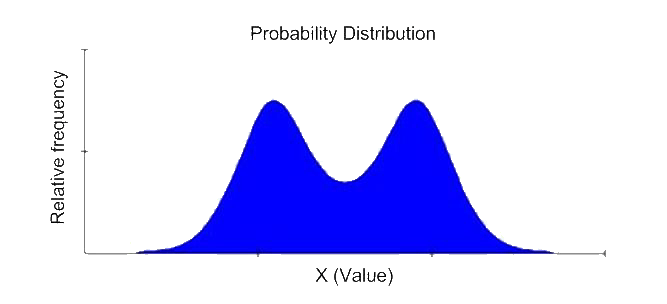 The "rich" climbers (on the upper side of this distribution) seem to care little about the plight of the Sherpa (on the lower side of the distribution), step over dead bodies en route to the summit and complain of minor aches and pains while Sherpa sit patiently with grave wounds. The Sherpa get exploited by these rich westerners; they do all the work to support the needs of ill-prepared dreamers who lack sufficient mountaineering experience. These stories outrage readers - as they should - but their credibility remains suspect.
Readers interested in Mt. Everest surely know these comparisons by now. The media use a woman in high heeled shoes, a rich, overweight tycoon, or a spoiled, trust-funded teenager to prove their point. Where are the postal workers, college professors, young management consultants, or beauticians who scrimp and save their hard-earned income to pursue their dreams? Additionally, the media interview a few select Sherpa who choose to retire from climbing citing danger and family pressure as the reasons for retirement. These recent retirees never report their relative fortunes from climbing. Instead, we hear about the poor Sherpa villagers who earn less in a year than the average American pays monthly for their car payment. Absent also in these interviews are the growing number of young Sherpa who see climbing as a route out of poverty. A climbing Sherpa makes more in a month than any other member of their community makes in a year - often more than the entire village combined.
So, why the polarization of wealth? I suspect it appeals to the public. The Sherpa think we are all rich. We are rich, to be sure, if you compare our annual income to theirs. That absolute comparison, however, ignores the relative cost of living. The beautician has less discretionary income compared to the "poor" Sherpa climber. How do I know this? I asked them. The former takes out loans, remortgages her house, and pleads with sponsors to give her part of the expedition fees. Everest ain't cheap. The climbing Sherpa earn enough money from a single expedition to support not only their own family but also their extended family. How many college professors or beauticians earn that much money? None that I know and I know about 200+ people who fit that bill.
Rather than polarize the issue, why not focus on the symbiotic relationship that exists between Everest climbers and the Sherpa community? We climbers need the Sherpa to an extent and the Sherpa community, likewise, need the climbers to an extent. That "need" may be a stretch. Nobody needs to climb but people need money or resources to survive. We exchange these "needs" in a way that form a reasonable market. That market, however, gets corrupted by the constant media attention of wealth disparity. Reasonable people certainly disagree on this point. All I ask is that we remain reasonable. Ignore the constant polarization between climber and Sherpa. We are all complicit in this market. Let us climb and let them earn; the market will dictate the prices and exchanges.
Reflection 3. Misinformation increases proportionate to the distance from the actual events. As a two-time participant in Everest disasters, I came away with only one certainty - misinformation propagates rapidly. The further you move away from the epicenter of an event, the greater that misinformation grows. Everest seems to even magnify that effect. My expedition mates with SummitClimb witnessed one aspect of the earthquake this year. We endured the shake, rattle, and roll of the ground along with the tail end of a massive avalanche. Our experience differed from those of the basecamp inhabitants just as we all differed from those who were trapped in the Khumbu icefall or within their homes in the affected areas around Kathmandu.
One thing we all experienced was ignorance of what took place in other areas beyond our own. Only by going to these areas and talking to those who experienced the direct effects could we slowly piece together what actually took place. The purported war-torn areas of Kathmandu look scarcely different than they did prior to our departure. I have scores of pictures of perfectly intact buildings in and around Kathmandu. Sure, there are some structures - mostly poorly contructed walls - that bore the brunt of the earthquake.
Meanwhile, the media flocked to nearby areas, interviewed some of the observers, and began forming impressions based upon these first or second-hand accounts. My account above stands guilty of that charge as well. The devastation seemed total and absolute from our vantage point because we had no clue and relied upon the observations of others. We heard outrageous fatality numbers that slowly increased as we walked away from the affected areas. Still today, no verified mortality figures exist for any of the areas affected by these natural events. Anywhere from 3 to 30 people died in the icefall while 3,000 to 10,000 perished in Nepal overall on April 25th - all depending upon who you ask. How many actually died? We have no clue but that state of ignorance does not inhibit some from hazarding a guess. Ignore those guesses. Ignore the media estimates. Wait until the dust settles before jumping to conclusions. Unless you directly observe something, assume nothing and take all estimates as questionable at best.
Reflection 4. Global Rescue earns top honors. I depart now from some critical comments to praise an organization that not only deserves praise but also deserves more subscribers. Go ahead and ask anyone who has climbing insurance from Global Rescue or from one of their competitors. The folks at Global Rescue organized our evacuation from start to finish. Once we realized that our climb was over and our situation at Camp 1 remained precarious, I placed a sat-phone call to my wife to initiate our evacuation. That call started a cascade of events that required little on my part. The Global Rescue folks knew me, my mates, and our situation. My wife called several times and felt complete confidence in their handling of the situation. My two climbing pals - Sam Chappatte and Alex Schneider - used British Mountaineering Council insurance and found the experience with them to be less-than-satisfactory. How unsatisfactory? Well, Sam essentially told the BMC representatives to contact Global Rescue to coordinate their evacuation. Yep, no faith in BMC. Meanwhile, my mate Jim Grieve and I simply sat back and watched the great service unfold before our eyes. Global Rescue also evacuated our entire SummitClimb team from Camp 1. I am and will remain a die-hard supporter of Global Rescue.
Reflection 5. Nationalism ain't my thing but I sure was proud to be an American. Picture this....I am on a helicopter platform at Everest Basecamp (EBC). We waited patiently from about 6am until 8am alone atop this mound. Slowly and without much warning, the platform population increased from roughly 5 of us to over 40 people all wanting out of EBC. Finally, a helicopter landed to the applause of many anxious climbers ready to flee the EBC nightmare. Two guys in civilian clothes hopped out of the helicopter and approached me directly. One of them asked me "are you Patrick McKnight?" to which I promptly said "yes." They immediately said they were US special forces and their directive was to evacuate me and my fellow Americans from Nepal. Even my British mates were impressed; some immediately wanted to switch citizenship. While I write this post, I still get goosebumps thinking about how cool it was that the US government sent in these well-trained guys to help us recreational mountaineers. Hats off to these guys. Sure, their efforts might be better spent helping out the more needy but I was glad to see them. Thanks guys. I owe you a pint when we meet again. Next time, let's meet at the pub rather than on a helicopter pad at EBC.
I have more thoughts but I will end today's post so I can get a beer to celebrate the final leg of my evacuation. Of course, Global Rescue organized my flight to the US after just one email. Thanks to you all for thinking of me and pulling for us during this terrible time. I am humbled to say the least and I hope to repay you all for your love and kindness.
NOTE: I deliberately omitted any links to the articles I refer to below. My efforts here should not give these pieces more attention than they deserve.
Reflection 1. Bad intentions are rare but seem more prevalent from media reports. Many recent articles depict selfish individuals who pursue their own narcissitic goals at the expense of others. The anecdotes of these "bad actors" gain greater credibility when they come from western climbers calling out their fellow climbers. One article even quoted a multi-millionaire climber who said he felt sick - to the point of wanting to vomit - because his fellow expedition members expressed interest in climbing rather than helping the poor and needy in Nepal. Anecdotes like these only serve to increase the public's perception of climbers' bad intentions. There are no bad intentions based upon my seemingly endless conversations with climbers. There are competing goals and incomplete knowledge that appear as bad behaviors driven by bad intentions.
Before casting judgment on others, ask yourself why someone may act in a way that runs contrary to how you think he or she ought to act. Don't rely on the same tired inferences; actually think about what might lead someone to behave the way they behave. I suspect that this brief exercise might enable you - the consumer - to be a bit more charitable to all those involved. You might even find that these bad intentions are rare afterall.
Reflection 2. Rich vs. Poor articles polarize rather than galvanize the community. These articles present a bimodal distribution of Everest participants.
Readers interested in Mt. Everest surely know these comparisons by now. The media use a woman in high heeled shoes, a rich, overweight tycoon, or a spoiled, trust-funded teenager to prove their point. Where are the postal workers, college professors, young management consultants, or beauticians who scrimp and save their hard-earned income to pursue their dreams? Additionally, the media interview a few select Sherpa who choose to retire from climbing citing danger and family pressure as the reasons for retirement. These recent retirees never report their relative fortunes from climbing. Instead, we hear about the poor Sherpa villagers who earn less in a year than the average American pays monthly for their car payment. Absent also in these interviews are the growing number of young Sherpa who see climbing as a route out of poverty. A climbing Sherpa makes more in a month than any other member of their community makes in a year - often more than the entire village combined.
So, why the polarization of wealth? I suspect it appeals to the public. The Sherpa think we are all rich. We are rich, to be sure, if you compare our annual income to theirs. That absolute comparison, however, ignores the relative cost of living. The beautician has less discretionary income compared to the "poor" Sherpa climber. How do I know this? I asked them. The former takes out loans, remortgages her house, and pleads with sponsors to give her part of the expedition fees. Everest ain't cheap. The climbing Sherpa earn enough money from a single expedition to support not only their own family but also their extended family. How many college professors or beauticians earn that much money? None that I know and I know about 200+ people who fit that bill.
Rather than polarize the issue, why not focus on the symbiotic relationship that exists between Everest climbers and the Sherpa community? We climbers need the Sherpa to an extent and the Sherpa community, likewise, need the climbers to an extent. That "need" may be a stretch. Nobody needs to climb but people need money or resources to survive. We exchange these "needs" in a way that form a reasonable market. That market, however, gets corrupted by the constant media attention of wealth disparity. Reasonable people certainly disagree on this point. All I ask is that we remain reasonable. Ignore the constant polarization between climber and Sherpa. We are all complicit in this market. Let us climb and let them earn; the market will dictate the prices and exchanges.
Reflection 3. Misinformation increases proportionate to the distance from the actual events. As a two-time participant in Everest disasters, I came away with only one certainty - misinformation propagates rapidly. The further you move away from the epicenter of an event, the greater that misinformation grows. Everest seems to even magnify that effect. My expedition mates with SummitClimb witnessed one aspect of the earthquake this year. We endured the shake, rattle, and roll of the ground along with the tail end of a massive avalanche. Our experience differed from those of the basecamp inhabitants just as we all differed from those who were trapped in the Khumbu icefall or within their homes in the affected areas around Kathmandu.
One thing we all experienced was ignorance of what took place in other areas beyond our own. Only by going to these areas and talking to those who experienced the direct effects could we slowly piece together what actually took place. The purported war-torn areas of Kathmandu look scarcely different than they did prior to our departure. I have scores of pictures of perfectly intact buildings in and around Kathmandu. Sure, there are some structures - mostly poorly contructed walls - that bore the brunt of the earthquake.
Meanwhile, the media flocked to nearby areas, interviewed some of the observers, and began forming impressions based upon these first or second-hand accounts. My account above stands guilty of that charge as well. The devastation seemed total and absolute from our vantage point because we had no clue and relied upon the observations of others. We heard outrageous fatality numbers that slowly increased as we walked away from the affected areas. Still today, no verified mortality figures exist for any of the areas affected by these natural events. Anywhere from 3 to 30 people died in the icefall while 3,000 to 10,000 perished in Nepal overall on April 25th - all depending upon who you ask. How many actually died? We have no clue but that state of ignorance does not inhibit some from hazarding a guess. Ignore those guesses. Ignore the media estimates. Wait until the dust settles before jumping to conclusions. Unless you directly observe something, assume nothing and take all estimates as questionable at best.
Reflection 4. Global Rescue earns top honors. I depart now from some critical comments to praise an organization that not only deserves praise but also deserves more subscribers. Go ahead and ask anyone who has climbing insurance from Global Rescue or from one of their competitors. The folks at Global Rescue organized our evacuation from start to finish. Once we realized that our climb was over and our situation at Camp 1 remained precarious, I placed a sat-phone call to my wife to initiate our evacuation. That call started a cascade of events that required little on my part. The Global Rescue folks knew me, my mates, and our situation. My wife called several times and felt complete confidence in their handling of the situation. My two climbing pals - Sam Chappatte and Alex Schneider - used British Mountaineering Council insurance and found the experience with them to be less-than-satisfactory. How unsatisfactory? Well, Sam essentially told the BMC representatives to contact Global Rescue to coordinate their evacuation. Yep, no faith in BMC. Meanwhile, my mate Jim Grieve and I simply sat back and watched the great service unfold before our eyes. Global Rescue also evacuated our entire SummitClimb team from Camp 1. I am and will remain a die-hard supporter of Global Rescue.
Reflection 5. Nationalism ain't my thing but I sure was proud to be an American. Picture this....I am on a helicopter platform at Everest Basecamp (EBC). We waited patiently from about 6am until 8am alone atop this mound. Slowly and without much warning, the platform population increased from roughly 5 of us to over 40 people all wanting out of EBC. Finally, a helicopter landed to the applause of many anxious climbers ready to flee the EBC nightmare. Two guys in civilian clothes hopped out of the helicopter and approached me directly. One of them asked me "are you Patrick McKnight?" to which I promptly said "yes." They immediately said they were US special forces and their directive was to evacuate me and my fellow Americans from Nepal. Even my British mates were impressed; some immediately wanted to switch citizenship. While I write this post, I still get goosebumps thinking about how cool it was that the US government sent in these well-trained guys to help us recreational mountaineers. Hats off to these guys. Sure, their efforts might be better spent helping out the more needy but I was glad to see them. Thanks guys. I owe you a pint when we meet again. Next time, let's meet at the pub rather than on a helicopter pad at EBC.
I have more thoughts but I will end today's post so I can get a beer to celebrate the final leg of my evacuation. Of course, Global Rescue organized my flight to the US after just one email. Thanks to you all for thinking of me and pulling for us during this terrible time. I am humbled to say the least and I hope to repay you all for your love and kindness.
Friday, May 1, 2015
Check-in/OK message from SPOT PEM
PEM
Latitude:27.71171
Longitude:85.32006
GPS location Date/Time:05/01/2015 07:36:49 EDT
Message:Climbing in Mt. Everest right now. All is well; please check the map to see our progress.
Click the link below to see where I am located.
http://fms.ws/NBEo7/27.71171N/85.32006E
If the above link does not work, try this link:
http://maps.google.com/maps?f=q&hl=en&geocode=&q=27.71171,85.32006&ll=27.71171,85.32006&ie=UTF8&z=12&om=1
PEM
You have received this message because PEM has added you to their SPOT contact list.
Ready for Adventure
FindMeSPOT.com
Latitude:27.71171
Longitude:85.32006
GPS location Date/Time:05/01/2015 07:36:49 EDT
Message:Climbing in Mt. Everest right now. All is well; please check the map to see our progress.
Click the link below to see where I am located.
http://fms.ws/NBEo7/27.71171N/85.32006E
If the above link does not work, try this link:
http://maps.google.com/maps?f=q&hl=en&geocode=&q=27.71171,85.32006&ll=27.71171,85.32006&ie=UTF8&z=12&om=1
PEM
You have received this message because PEM has added you to their SPOT contact list.
Ready for Adventure
FindMeSPOT.com
Check-in/OK message from SPOT PEM
PEM
Latitude:26.48437
Longitude:87.26620
GPS location Date/Time:05/01/2015 00:11:59 EDT
Message:Climbing in Mt. Everest right now. All is well; please check the map to see our progress.
Click the link below to see where I am located.
http://fms.ws/NAz0S/26.48437N/87.26620E
If the above link does not work, try this link:
http://maps.google.com/maps?f=q&hl=en&geocode=&q=26.48437,87.26620&ll=26.48437,87.26620&ie=UTF8&z=12&om=1
PEM
You have received this message because PEM has added you to their SPOT contact list.
Ready for Adventure
FindMeSPOT.com
Latitude:26.48437
Longitude:87.26620
GPS location Date/Time:05/01/2015 00:11:59 EDT
Message:Climbing in Mt. Everest right now. All is well; please check the map to see our progress.
Click the link below to see where I am located.
http://fms.ws/NAz0S/26.48437N/87.26620E
If the above link does not work, try this link:
http://maps.google.com/maps?f=q&hl=en&geocode=&q=26.48437,87.26620&ll=26.48437,87.26620&ie=UTF8&z=12&om=1
PEM
You have received this message because PEM has added you to their SPOT contact list.
Ready for Adventure
FindMeSPOT.com
Thursday, April 30, 2015
Waiting at Lukla
It's 2pm EST on April 30. Spoke with Pat last night and this morning. He and his team are at Lukla, and it's a chaotic mess, as you can imagine. When I spoke with Global Rescue about the situation, my contact said it's like trying to empty a full football stadium 1 car at a time. Word is that Global Rescue will pick them up tomorrow. In the meantime, they've miraculously found them a hotel for the night and Pat and team have food and water, so they're safe there. The US Embassy is prioritizing evacuating the injured from that area, as they should. So for healthy people with resources, it's about being patient and not getting caught up in rushing the choppers & planes as they land, to get on & down to Kathmandu. The GR guy said it's actually better to be in Lukla right now than Kathmandu. They're even encouraging their clients who are trekking down from Base Camp to Lukla to take their time, if they have enough supplies, because it's going to get worse for awhile.
On another note, saw a few neighbors yesterday as I walked our dogs and I just want to say how amazing & supportive they've been -- kind words, offers of food, drive-by hugs even! We're so lucky to have such good peeps around us, in our neighborhood, online, on the phone, in prayers and good vibes :)
Many many thanks
Kathy
On another note, saw a few neighbors yesterday as I walked our dogs and I just want to say how amazing & supportive they've been -- kind words, offers of food, drive-by hugs even! We're so lucky to have such good peeps around us, in our neighborhood, online, on the phone, in prayers and good vibes :)
Many many thanks
Kathy
Check-in/OK message from SPOT PEM
PEM
Latitude:27.68732
Longitude:86.73244
GPS location Date/Time:04/30/2015 07:38:40 EDT
Message:Climbing in Mt. Everest right now. All is well; please check the map to see our progress.
Click the link below to see where I am located.
http://fms.ws/N9r5P/27.68732N/86.73244E
If the above link does not work, try this link:
http://maps.google.com/maps?f=q&hl=en&geocode=&q=27.68732,86.73244&ll=27.68732,86.73244&ie=UTF8&z=12&om=1
PEM
You have received this message because PEM has added you to their SPOT contact list.
Ready for Adventure
FindMeSPOT.com
Latitude:27.68732
Longitude:86.73244
GPS location Date/Time:04/30/2015 07:38:40 EDT
Message:Climbing in Mt. Everest right now. All is well; please check the map to see our progress.
Click the link below to see where I am located.
http://fms.ws/N9r5P/27.68732N/86.73244E
If the above link does not work, try this link:
http://maps.google.com/maps?f=q&hl=en&geocode=&q=27.68732,86.73244&ll=27.68732,86.73244&ie=UTF8&z=12&om=1
PEM
You have received this message because PEM has added you to their SPOT contact list.
Ready for Adventure
FindMeSPOT.com
Wednesday, April 29, 2015

Tuesday, April 28, 2015
Check-in/OK message from SPOT PEM
PEM
Latitude:27.89407
Longitude:86.81974
GPS location Date/Time:04/28/2015 23:59:33 EDT
Message:Climbing in Mt. Everest right now. All is well; please check the map to see our progress.
Click the link below to see where I am located.
http://fms.ws/N7-Vk/27.89407N/86.81974E
If the above link does not work, try this link:
http://maps.google.com/maps?f=q&hl=en&geocode=&q=27.89407,86.81974&ll=27.89407,86.81974&ie=UTF8&z=12&om=1
PEM
You have received this message because PEM has added you to their SPOT contact list.
Ready for Adventure
FindMeSPOT.com
Latitude:27.89407
Longitude:86.81974
GPS location Date/Time:04/28/2015 23:59:33 EDT
Message:Climbing in Mt. Everest right now. All is well; please check the map to see our progress.
Click the link below to see where I am located.
http://fms.ws/N7-Vk/27.89407N/86.81974E
If the above link does not work, try this link:
http://maps.google.com/maps?f=q&hl=en&geocode=&q=27.89407,86.81974&ll=27.89407,86.81974&ie=UTF8&z=12&om=1
PEM
You have received this message because PEM has added you to their SPOT contact list.
Ready for Adventure
FindMeSPOT.com
Check-in/OK message from SPOT PEM
PEM
Latitude:28.00379
Longitude:86.85315
GPS location Date/Time:04/28/2015 19:14:35 EDT
Message:Climbing in Mt. Everest right now. All is well; please check the map to see our progress.
Click the link below to see where I am located.
http://fms.ws/N7lY6/28.00379N/86.85315E
If the above link does not work, try this link:
http://maps.google.com/maps?f=q&hl=en&geocode=&q=28.00379,86.85315&ll=28.00379,86.85315&ie=UTF8&z=12&om=1
PEM
You have received this message because PEM has added you to their SPOT contact list.
Ready for Adventure
FindMeSPOT.com
Latitude:28.00379
Longitude:86.85315
GPS location Date/Time:04/28/2015 19:14:35 EDT
Message:Climbing in Mt. Everest right now. All is well; please check the map to see our progress.
Click the link below to see where I am located.
http://fms.ws/N7lY6/28.00379N/86.85315E
If the above link does not work, try this link:
http://maps.google.com/maps?f=q&hl=en&geocode=&q=28.00379,86.85315&ll=28.00379,86.85315&ie=UTF8&z=12&om=1
PEM
You have received this message because PEM has added you to their SPOT contact list.
Ready for Adventure
FindMeSPOT.com
Wrapping Up
Oh happy day! It's 7:30am EST & I just spoke with Pat. He & the entire team are off Camp 1 & in Base Camp. Global Rescue saved the day -- they were the only ones with a heli up there & they got everyone down. They will be inundated with chocolate & flowers :)
The plan is for him, along with 3 of his climbing mates James, Sam & Alex, to get picked up tomorrow morning Nepal time, & flown into Kathmandu off the mountain. They will see a completely different city than the one they flew into. But they've seen that at Base Camp too. Pat said his tent was right up against the ridge where the avalanche hit. He found his stuff, and miraculously, all that happened was that his tent was flipped over. I'm glad he wasn't in it.
He told me what happened to him up at Camp 1. You'll have to get the story yourselves from him -- no doubt it will be here in his blog, told in the way only the Irish can manage :) By the way, I'm Irish & I didn't get that gift. I got the height (ha ha).
I'll update this blog when he gets into Kathmandu. And then I'm giving it back to him. Gladly!
Thank you all for your amazing emails, texts, calls, prayers, love & support. Some of you were afraid you were bothering me -- quite the opposite. You were holding me up. I am forever grateful for our amazing friends & family, & those who I don't even know who were there to help anyway. Truly amazing people you are.
A super grateful Kathy
p.s. Satellite phone reception isn't the best on the mountain, so I couldn't always hear Pat very well. When he was spelling the name of his sat phone service so I could add more minutes, he had to use the NATO alphabet (alpha, beta, charlie) -- but he didn't know which word to use for the letter U, so he said urethra. REALLY?! I laughed so hard.
The plan is for him, along with 3 of his climbing mates James, Sam & Alex, to get picked up tomorrow morning Nepal time, & flown into Kathmandu off the mountain. They will see a completely different city than the one they flew into. But they've seen that at Base Camp too. Pat said his tent was right up against the ridge where the avalanche hit. He found his stuff, and miraculously, all that happened was that his tent was flipped over. I'm glad he wasn't in it.
He told me what happened to him up at Camp 1. You'll have to get the story yourselves from him -- no doubt it will be here in his blog, told in the way only the Irish can manage :) By the way, I'm Irish & I didn't get that gift. I got the height (ha ha).
I'll update this blog when he gets into Kathmandu. And then I'm giving it back to him. Gladly!
Thank you all for your amazing emails, texts, calls, prayers, love & support. Some of you were afraid you were bothering me -- quite the opposite. You were holding me up. I am forever grateful for our amazing friends & family, & those who I don't even know who were there to help anyway. Truly amazing people you are.
A super grateful Kathy
p.s. Satellite phone reception isn't the best on the mountain, so I couldn't always hear Pat very well. When he was spelling the name of his sat phone service so I could add more minutes, he had to use the NATO alphabet (alpha, beta, charlie) -- but he didn't know which word to use for the letter U, so he said urethra. REALLY?! I laughed so hard.
Subscribe to:
Posts (Atom)