Sunday, February 25, 2018

42 Days Remain: Gear sort starting with me feet...

Welcome back to my adventure.  Starting today, I intend to provide more details about my gear and trip preparation.  Believe it or not, these posts help me organize my thinking about the climb.  Nothing helps me more than to review my gear and climbing plan.  Over the next few weeks, I plan to cover both topics - first my gear - and to post about gear relevant to each of the major body parts starting with my feet and ending with my head.   Along the trip up north through my body, you will learn about the gear I plan to take and when I plan to use it.  Brendan (my climbing buddy) and I spent some time organizing a Google sheet with all our gear.  Care to see the entire list?  Well, here it is.  We have many items on our list and some may end up staying home.  Until we finalize the list, expect it to change routinely until we depart.

My Foot Gear

Travel footwear from VA to Chinese Base Camp (CBC):  My trusted flip-flops.  These OluKai sandals (and their ancestors before them) traveled the world with me.  
I may replace this pair with a relatively new pair.  Nah....
CBC to Interim Camp and perhaps Advanced Base Camp (ABC):  Approach shoes.  I intend to either use my GoLite approach shoes - the same I wore to the summit of Aconcagua - or a new pair of Addidas trail running shoes if they fit and I can break them in before I leave.  Bad idea to break in new shoes on a big climb.  Blisters just don't heal at 6000m (20,000 feet) and above.

These GoLite approach shoes are comfortable but they have seen better days.  I ran them through 3 or 4 washing machine cycles to finally rinse the dirt off.  They might not be up for the journey.  I might use these Addidas trail runners instead.  

No, I don't have them yet.  They are en route from Moosejaw.com (don't ask).  

Advanced Base Camp and above:  Mountaineering boots.  I have a nice pair of La Sportiva Olympus Mons.  Right now, they are drying out from today's workout but I can give you a quick glimpse of the outer shells and liners - they both stink from sweat but I can spare a second to take a picture and then run them back into the gym where they can stink up that place and spare my office. 

The outer boot is to the left and the liner is on the right.  I intend to wear these for long stretches - not the outer boots unless I am climbing but the liners.  Those liners are comfortable.  I might even say they are as comfortable as bedroom slippers now.  

Against my skin:  I wear socks of course.  Well, actually, "of course" should not be taken for granted.  I know several people who never wear socks - even when climbing on glaciers.  They hate 'em.  I don't mind socks if I must wear closed toe shoes.  Here is an assortment of socks I plan to bring.  I intend to bring several pairs of some and only one pair of others.  

The leftmost pair of socks are my night time socks.  I put these over my feet with a healthy dose of foot powder to dry out my feet.  Nothing worse than trench foot when climbing.  Big thick wool mountaineering socks with Gold Bond Maximum Strength foot power does the trick every night.  The gray pair next to my mountaineering socks are my everyday climbing socks.  REI makes a great mid-weight sock that holds up over years.  I like these and they treat my feet well.  Even better for my feet for long days are two pairs of socks on the right - my compression socks.  The colorful pair are great but have probably seen better days.  The black pair are relatively new and will serve me well on Everest.  These compression socks help my feet by squeezing them all day.  I do get blisters from them on occasion so I intend to wear my newfound love - the vapor barrier sock (aka plastic bags) on my feet between the skin and the sock.  These bags inhibit blistering and also keep my feet from sweating too much.  Well, at least that is the plan.  So far, the bags just make my feet sweat buckets.  

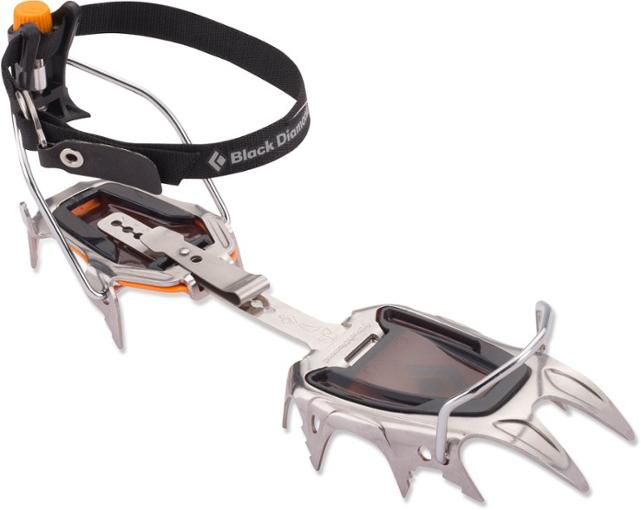
Climbing gear for my feet:  Crampons.  I like the Black Diamond Sabertooth Pro model but had some problems with them in 2015.  The heel piece broke unexpectedly after light use.  I brought only one pair to Everest that year and had to beg a few folks at basecamp for some spare parts.  This year, I have two pairs with multiple spare parts.  I have no intention of jeopardizing my climb because a little piece of plastic fails.  Here are my older pair:

You can see the heel pieces are different than the typical model that has a micro-adjustable skimpy heel piece as seen in the BD advertisement:
Black Diamond Sabretooth Pro Crampons - Pair Polished
The heel piece broke in my "old" pair so I have an improvised replacement and then I have a relatively new pair for both use and parts.  

Walking around camps (ABC and below):  REI down booties.  Oh yeah...these babies have seen it all and lived to tell about the adventures.  I love these down booties.  They are rugged and inexpensive.  My only gripe (and it is a minor one) is that my mountaineering socks are so bulky that they tend to squish my feet when I have my socks on when wearing my booties.  Next time, I plan to purchase a pair about 3 sizes too big for my feet.  Here are my friends:

Yeah, sure they look a little shaggy but these booties are warm.  You cannot go wrong with down booties.  REI makes a fine pair.

I am sure there are other things that I omitted in this post.  Sure, I have a ton of blister bandages and antibiotic creme that comes in handy but those things are not terribly unique to climbing Everest.  So there you have it!  My footwear gear collectively weighs about 4.5 kg or about 10 lbs.  I do not plan to lug all that weight up to the summit.  Some of these items remain at CBC while others accompany me for most of the climb (i.e., my mountaineering boots and socks).  

Thanks for following along.  Next post...what I wear on my legs.  Oooh, I know you can't wait.  See you in a few days.

Tuesday, February 20, 2018

47 Days Remain: Hypoxic sleeping....in a tent...indoors.

As promised, I am going to take you on a tour of my hypoxic sleeping setup and routine.  Here is my tent:


Inside the tent, I have all the luxuries including a fingertip pulse oximeter (for measuring my spO2 in the morning), an oxygen meter (for measuring the ambient oxygen level), toilet paper (for blowing my constantly running nose throughout the night), heart rate chest strap (for measuring my morning heart rate variability or HRV), Nalgene bottle (to quench my thirst through the night), comfortable pillow, and snacks (for obvious reasons).  All of these items fit snugly along with my upper body in the tent.  

Every night, I go to sleep between 8 and 9pm and plan for at least 8 contiguous hours of sleep.  Well, I say plan because I rarely sleep soundly for 8 hours.  Often, I wake up every other hour to drink some water or pee.  A side note for the latter activity might be necessary to explain how I stay in the tent for at least 8 hours.  Peeing requires a bottle.  I'll leave the gory details to your imagination.

My Hypoxico units sit along the wall in my exercise room (adjacent to my bedroom).  I ran the hoses through the wall so that I could keep the units away from the bedroom and in a cooler location.  Also, these units generate a ton of heat when they run overnight.  Locating them one room away allows me to have a sound night sleep without the additional heat and noise.  Here are the units:


See the hose that runs from the right-most unit?  That hose runs through the wall and into my bedroom.  These units strip the oxygen from the room air and pump that oxygen-depleted air into my tent.  The units have setting numbers that do not correspond exactly to the oxygen percent or any other value that makes sense.  I found that the units could loosely be calibrated by simply tracking the settings and plotting those settings to the observed oxygen percentage inside the tent.  Below is a snapshot of that calibration:


You'll note that the variability of the oxygen percentage varies quite a bit for each setting value.  I noticed this variability the more I observed the correspondence between these two variables.  Perhaps a more interpretable figure is the one that shows the relationship between the unit settings and the simulated oxygen levels (in Feet):


I have a few more setting units left on the scale to go but you can see clearly that my sleeping altitude is now about as high as these Hypoxico machines go.  What do these values mean in terms of my adaptation?  Well....they make it tough on my body for sure.  For those of you with extensive medical training, avert thy eyes.  You might get a shock from some of the numbers.  Fear not!  I am alive and doing quite well.  Here are spO2 values for each of the unit settings:

Yeah, some days are harder than others.  You can see that my spO2 drops with each successive value on the Hypoxico unit.  Over time, however, I tend to acclimatize to the oxygen levels and my spO2 improves.  How much does it improve?  Not enough to keep me out of the emergency room for those who know what these numbers mean.  A healthy person has an spO2 in the upper 90 percent range (I measure about 99% at sea level).  On setting 5 (as indicated in the figure above) using the high altitude adapter on full, I have a median spO2 of about 84%.  Contrast that number with my median spO2 of 71 on setting 6.5 with the adapter on full.   You can see that the response to the oxygen depletion is quite dramatic.  On about the 4th or 5th day of sleeping at each setting, I typically wake up with higher spO2 values and feel great; the first days on each setting can be quite rough.  So I feel an improvement even though I cannot observe that improvement by my spO2 values.  

All of these figures fail to tell the real story.  I need to explain what I am doing.  Here is a snapshot of my hypoxic acclimatization process.  I began my hypoxic sleep training in earnest on January 8th, 2018 by setting my Hypoxico unit to "9" (without the high altitude adapter) and sleeping blissfully for 9 hours.  NOTE:  I actually began sleeping in the tent on July 23rd, 2017 when I returned from a wonderful trip to Ireland.  OK, back to my "earnest" training. Setting 9 resulted in a oxygen concentration in the tent air of 13.6% or an equivalent altitude of 11,100 feet (3383m).  My spO2 in the morning was 88% or good enough to land me into the emergency room for most normal people.  Most of you realize I am not normal so that hospital trip would be a waste.  After about 5 days, I changed the unit setting by 0.5 to simulate a slightly higher altitude.  Each increase leads to a slight decrease in my spO2 (see figure above for some idea about how much change I observe).  

By sleeping every night at a simulated altitude, I increase my red blood cell count and potentially increase the oxygen carrying capacity of those red blood cells (by increasing the hemoglobin).  There are some conflicting views on the effectiveness of this process but I assure the most ardent skeptic that there is no way I could trek to Everest Basecamp in 2 days had it not been for the hypoxic sleep training I did in 2015.

Hopefully these tidbits provided you with some glimpse into one aspect of my training routine - my hypoxic sleep training.  During my next "rest day," I intend to describe some of my gear - starting with my feet.  With 47 days left, I have approximately 11 more full rest days to report on my preparation.  My sinus infection is now gone and I feel great.  With 43 days remaining, you will learn what I plan to wear on my feet.  Each successive post focuses on another part of my body's gear until I end with my head.  So, stay tuned for a foot to head detail of my gear.  

Thanks for following my adventure.

Friday, February 16, 2018

51 Days Remain: Rest days are not always restful

As promised, today's post includes multimedia amusement.  I recorded some video (unedited but brief) documenting what I do on a regular rest day.  Some of what I documented is my usual routine (movement prep, core, and stretching) whereas other bits are typical of my rest days.  Since today is a rest day, you now have a good idea about what I do during my 74 minutes of training.  On these rest days, I don't run, lift, or do any strenuous cardio training.  Instead, I focus on recovery and do a little hypoxic training so my brain is ready for the strange sensation of exerting an effort with little oxygen.  So, let me walk you through the videos.

First, I begin my day - every day in fact - with movement prep(aration).  The objective with these exercises is to warm up my body and get ready for the real deal.  Movement prep is every bit as important as any other aspect of my training.  Here I am demonstrating a typical movement prep routine:


Once my body is ready for more strenuous activity, I do my core exercise routine.  My back is rather fragile.  Too many years of skiing and training without proper care left my back susceptible to all sorts of nasty things...including sciatica (not recommended at all).  So my core routine varies from day-to-day but this one is a typical one when I just need to do it!


On a typical workout day, I follow up the core workout with a strength or resistance training routine.  I use the same tabata timer as I used in the video above but I do legs on the 1st and 3rd days of my 3 days on, 1 day off cycles; on the middle or 2nd day of the 3 day on cycle, I lift with my upper body.  Since today is a rest day, I didn't lift.  Later, I intend to take some video of my lifting routines but today I don't lift.  Also, once I am done with movement prep, core, and lifting, I typically run outdoors.  My runs are short but often high intensity so I can feel a little discomfort but also spare my knees of the added pain and suffering they don't deserve.

My rest day includes hypoxic training.  I provide a quick overview of my approach during the following video:


That elliptical workout often ends with me gasping for breath.  See...


Oh, but wait; there is more!  Once I finish my huge 10 minute workout on the elliptical, I then make a quick transition (note, I don't put on cycling shorts when I move from the elliptical to the bike - too long for too little gain).  


Finishing off the bike workout (again, another whopping 10 minutes), I stumble off the bike....


Now that I am done with the bulk of my day off, I finally get to stretch my muscles and gear up for the rest of my day....of work.  Ah, but first, I stretch:

My rest days do not consist solely of rest.  These are active rest days.  Some people do not take rest days when they are training for endurance events.  Many people find that rest days leave them flat.  Complete rest days make me feel flat and unmotivated.  I found that if I skipped the rest days to fully recover, I soon burned out and lost interest in training.  Striking a balance between too restful and not restful enough requires fine tuning on every athlete's part.  

Thanks again for following me during my preparation.  I realize you have plenty of other distractions on the internet and appreciate the fact that you distract yourself with my ramblings.  My next post will take you for a tour of my sleeping setup so you can see how my hypoxic sleep training unfolds every night.  See you in 4 days....

Tuesday, February 13, 2018

55 days to go: Three random and recurrent thoughts

Well...actually 54 days now.  Time sure is flying by.  I am chomping at the bit to head off but a few more things remain for me to sort out.  Below are three randomly recurring thoughts from the past few days.

1.  No matter how fit or prepare I am for these expeditions, there is always something that sneaks up and bites me.  That something is likely to be my sinuses.  I get sinus infections about 3 to 4 times each year.  The only year I successfully avoided them was when I prepared for my marathon swims.  For some odd reason, I seem to be able to fight them off when I am swimming every day for many hours.  Right now, I have a raging sinus infection.  Hopefully this one is the last infection I get before I leave.

2.  Training my brain is probably more important than training my body.  I spent the past 208 days training hard for this climb.  What I gained from it was more than just physical fitness; I gained mental fitness to help me overcome those points in the climb when I really need to dig deep.  My recent training days consist more of higher intensity training and less long, moderate slogs.  These higher intensity days test my mental resolve but no more so than the long "Summit Saturdays" I spent over the past few months.  I am ready mentally and know I am fit physically for any challenge.  The only problem...I have 53 more days until I depart.  My objective now is to stay healthy and refine any training to be ready for most if not all the mountain has to offer.

3.  Days off are just as important as days of training.  I am learning in my 5th decade that rest is just as important as exercise (and diet).  Combined, these facets of training offer me the most in preparation for this climb.  I take the rest when I schedule it and when my body seems to need more.  My recent sinus infection could be traced back almost two weeks ago (65 days remaining or 11 days ago) when my HRV readings started to indicate that my body was not fully recovering. Had I rested fully then, I might not be fighting this infection today.  Perhaps.  Maybe I am not that disciplined but I do plan to be more judicious about my rest moving forward.

I leave you once again with just a few tidbits of what inhabits my head these days.  All is well - despite feeling exhausted from this infection.  Over the next few weeks, I plan to do more strength training and maintaining my already strong aerobic base.  Next update (on Friday) will include some video of what I actually do on most of my workout days; come back and check them out.  Remember....

Work + Rest = Success!

Thanks for following.